
Agfa HealthCare
10 South Academy Street
Greenville, SC 29601
USA
AGFA HealthCare — Booth #2119 RSNA 2026
Brochures: Enterprise Imaging | Streaming Client | Workflow RUBEE Orchestration
Visit agfahealthcare.com/rsna26 to learn more.
At AGFA HealthCare, we believe technology should help clinicians reclaim their attention, not compete for it.
Our unified Enterprise Imaging platform brings imaging, workflow orchestration, AI, and advanced visualization into one cohesive clinical experience, helping reduce complexity and keep clinicians focused and in flow.
Designed to support imaging across the enterprise, the platform enables organizations to simplify operations, connect distributed teams, and deliver consistent access to the information clinicians need.
Whether cloud, hybrid, or on-premises, AGFA HealthCare Enterprise Imaging provides a flexible foundation that supports imaging today while evolving for what comes next.

RELATED CONTENT

Technology | Enterprise Imaging
October 18, 2016 — Agfa HealthCare announced today that it is releasing a new version of its Enterprise Imaging platform ...
 October 18, 2016

News | Digital Radiography (DR)
October 12, 2016 — Agfa Healthcare recently announced that its offerings at the 2016 annual meeting of the Radiological ...
October 12, 2016 
News | Enterprise Imaging
Agfa Healthcare recently announced that its offerings at the 2016 annual meeting of the Radiological Society of North America (RSNA) will center on the theme of “Care You Can See" across the company's entire product portfolio.
October 10, 2016 Sponsored Content | Videos | Digital Radiography (DR)
Agfa highlights how its digital radiography (DR) systems capture analytics data to help improve management of the ...
October 05, 2016 
Feature | Information Technology | Florian Schwiecker
The last two decades have brought a series of changes in medicine, technology and healthcare legislation that have impacted the field of diagnostic imaging and the role of the radiologist. Coupled with these changes, imaging volume is declining1 due to costs as well as concerns over patient radiation exposure.2 This environment often makes it challenging for radiology groups to protect their financial performance and ensure they deliver high-quality studies and readings. Fortunately, advances in imaging and information technology have emerged, helping radiologists increase the utilization of diagnostic imaging and moving the radiologist into a more central role in integrated patient care.3
October 04, 2016 
Feature | Digital Radiography (DR) | Greg Freiherr
The remaining users of film and computed radiography (CR) may get some carrot, if they transition to digital radiography (DR). It may come in the form of improved productivity, reduced X-ray dose to patients and better image quality. But the legislation that may spur the transition is all stick.
October 04, 2016 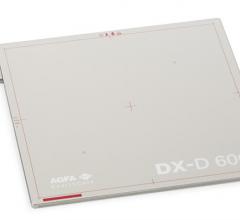
Technology | Digital Radiography (DR)
Agfa HealthCare has expanded its DX-D Retrofit line with the DX-D 60. This versatile, vendor-neutral direct radiography (DR) detector easily fits into existing radiography rooms and provides DR workflow without the higher cost of room replacement. In addition to virtually instant image access, technologists do not have to rotate the 17x17 inch DX-D 60 for radiology exams that would otherwise require portrait and landscape detector rotations, thus greatly improving image acquisition speed and workflow.
September 29, 2016 Feature | Radiation Dose Management | By Jeff Zagoudis
For all the benefits of medical diagnostic imaging, radiation exposure to both the patient and the operator remains a major safety concern. Various studies have illustrated the harmful effects of excess radiation dose, but much is still uncertain as to its precise impact.
September 07, 2016 
News | Enterprise Imaging
September 2, 2016 — The University of Mississippi Medical Center (UMMC) recently signed an agreement to build its ...
September 02, 2016 
News | Radiology Business
Agfa HealthCare announced that the U.S. government has awarded the company its DIN-PACS IV (Digital Imaging Network/Picture Archiving and Communication System) contract.
August 23, 2016 © Copyright Wainscot Media. All Rights Reserved.

Subscribe Now