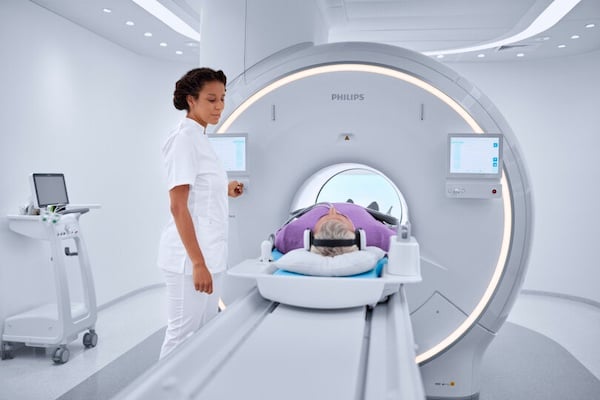
Philips BlueSeal helium-free magnet is compact and lightweight, allowing it to be installed in difficult and remote locations and improve access to advanced MRI. (Photo: Philips)
The majority of MRI scanners require about 1,500 liters of liquid helium to operate, but geopolitical unrest is putting severe strain on the helium supply chain, potentially reducing access to lifesaving scans.
The supply shock began in March when Iranian missile strikes shut down Qatar’s Ras Laffan Industrial City, which produces roughly 30% of the world’s helium.1 In response, helium prices doubled2 and U.S. distributors began rationing supplies.3
Though tensions between Iran and the United States are now easing, the Qatar facility may not be at full capacity for years4 and hospitals may see lingering impacts.
“This disruption started three months ago, and typically, MRI is a longer cycle,” says Ioannis Panagiotelis, PhD, business leader for MR at Philips. “You typically see the effect six to nine months later relative to the incident.”
An Ongoing Concern
While the current crisis is top of mind, helium shortages are nothing new. Panagiotelis, a 30-plus-year industry veteran, says he’s seen five serious supply disruptions over the past two decades. “It’s a problem that’s been deteriorating year after year,” he says.
This time, however, the crisis is markedly different. In addition to the Qatar plant shutdown, Russia has introduced export controls on helium through the end of 2027. Demand, meanwhile, is at an all-time high, driven by growth in MRI volume, semiconductor manufacturing, aerospace and nuclear fusion.
“There are probably about 70,000 MRI systems installed around the world, and MRI procedures are increasing in the high single digits year after year, which drives more MRI systems, which use more helium,” Panagiotelis says.
Risks to MRI Access
The biggest risk of any helium shortage is a magnet quench, a failure of a traditional MRI’s superconducting cooling system that causes liquid helium to rapidly boil off and escape. If there isn’t enough helium available to refill the machine, the MRI could be down for multiple weeks.
“This is really a question about access to MRI,” Panagiotelis says. “The typical around-the-world waiting time to receive helium in normal conditions, if you have a quench, so you can get your service up and running again, is two weeks to order,” he says.
Cost is another concern, Panagiotelis adds. “In most of the Asian countries today, outside of China, the price of helium is at least $50 per liter,” he says. “If you had a quench and it’s not covered in your service contract, you get an immediate hit of between $50,000 to $75,000.”
Alternatives to Traditional MRI
To help hospitals and radiology leaders build more resilient imaging infrastructures and reduce their exposure to future helium shortages, major device manufacturers are producing MRI systems that use significantly less helium.
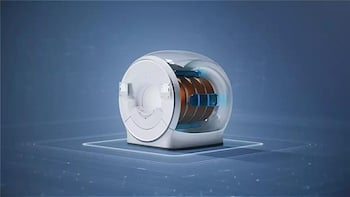
One example is Philips’ BlueSeal helium-free MRI system. It uses just 7 liters of helium in a fully sealed magnet, eliminating the need for helium refills over the system’s lifetime. The scanner weighs about half that of a standard MRI (2,300 kg), allowing it to be installed on higher hospital floors.
Unlike liquid helium systems, BlueSeal doesn’t require a quench pipe. It also contains significantly less metal than a traditional MRI, Panagiotelis says. This allows it to deliver higher image quality in certain demanding applications by reducing the risk of metallic artifacts that affect conventional MRIs.
While adoption of helium-free systems is growing (Philips alone has more than 2,400 helium-free magnets operating worldwide), roughly 65,000 MRI systems globally still rely on liquid helium, Panagiotelis estimates. As a result, he says, the industry needs a dual-track approach. Governments must help secure access to helium to maintain traditional MRI access, while device manufacturers must work toward reducing their dependence on helium.
“The resilience of our systems will be tested when they’re needed the most in situations of crisis,” Panagiotelis says. “Our objective is to effectively eliminate the dependence on helium in the near future [by] converting the totality of our portfolio to helium-free.”
References
- Han LK. The Iran war is threatening supply of a little-thought-of resource — helium. What it means for markets. CNBC. March 19. https://www.cnbc.com/2026/03/19/the-iran-war-is-threatening-supply-helium-what-it-means-for-markets.html
- Cheng E. Three niche commodity prices are surging. What they show about China’s grip on supply chains. CNBC. March 31. https://www.cnbc.com/2026/03/31/commodities-price-of-tungsten-sulfur-and-helium.html
- Haynes L. 2026 Helium shortage: why recovery will take years, not weeks. WestAir. May 21. https://westairgases.com/blog/helium-shortage/
- Gnana J. Months expected until Qatar’s Ras Laffan LNG site resumes full operations. The National. April 9. https://www.thenationalnews.com/business/energy/2026/04/09/months-expected-until-qatars-ras-laffan-lng-site-resumes-full-operations/

 October 07, 2026