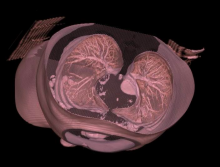
Digirad Corporation announced the launch of their Molecular Breast Imaging Accessory for the ergo imaging system, further expanding the clinical flexibility of the ergo imaging system for applications in the area of women’s health, as well as in nuclear medicine where the ergo imaging system is currently used for a wide variety of clinical applications.

Molecular Breast Imaging Accessory

Since its launch, less than two years ago, more than 5 million computed tomography (CT) scans, and nearly 3 million exams, have been added to the American College of Radiology (ACR) Dose Index Registry (DIR) — bringing the ACR closer to establishing national benchmarks for CT dose indices, which will help ensure patients receive safe, quality imaging care.


The March 2013 issue of The Atlantic, out this week, includes the article “The Robot Will See You Now,” which looks at how IBM's Watson — the same machine that beat Ken Jennings on Jeopardy — is now churning through case histories at the Memorial Sloan-Kettering Cancer Center, learning to make diagnoses and treatment recommendations.


Time Magazine releases the dramatic findings of a months-long investigation by contributor Steven Brill into how outrageous pricing and egregious profits are destroying America's healthcare and creating even deeper budget deficits. Brill spent seven months analyzing bills from hospitals, doctors, drug companies and every other player in the American healthcare ecosystem, following the money to find out exactly how and why we are overspending, where the money is going and how to get it back. What he discovered will radically change the way you think about our medical institutions. 


“Man is born free and is everywhere in chains.”      — Jean-Jacques Rousseau, 18th century philosopher

Not long ago images were read from lightboxes. Imaging archives were shelves upon shelves of patient jackets stuffed with films. Technologists hung images on a wall-sized alternator.

The American Society of Echocardiography (ASE) has joined the ABIM Foundation and 37 other specialty societies as part of Choosing Wisely, an effort to reduce inappropriate tests and procedures to improve care. This initiative aims to spark conversations about appropriate care between physicians and patients to help physicians provide the right care at the right time for the right patient.

Guerbet announced that the Medical Imaging Drugs Advisory Committee to U.S. Food and Drug Administration (FDA) has voted unanimously by votes of 17 to zero to recommend that FDA approve the New Drug Application (NDA) for Dotarem (gadoterate meglumine) for adults, and for pediatric use for children two years of age and older. The committee voted 10 to six (with one member abstaining) not to recommend at this time approval of the indication for children under two years of age.


Speech recognition vendors hope that just as front-end and back-end speech technology proved to cut costs and improve efficiency for transcription and image documentation, similar efficiencies can be found for electronic medical records (EMR). This and other insights can be found in a new KLAS report titled Speech Recognition 2013: Going from Back to Front and Beyond.

 
Subscribe Now