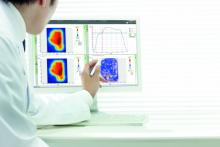
Plan optimization and dose calculation for complex VMAT plans are computationally challenging tasks. Depending on the efficiency of the TPS implementation, and the hardware on which it runs, calculation times can range from a few minutes to up to more than a half hour. It stands to reason that a dosimetrist equipped with a high performing system should be able to produce plans of higher quality compared to one equipped with a slow system irrespective of his/her experience level. This study aims to measure the effect of planning speed on plan quality. 


Computed tomography (CT) has enjoyed a place of prominence in medical imaging since its creation in the 1970s. The modality provides a more complete picture of the body than X-rays, its predecessor, taking images at several different angles to build a cross section, including bone and tissue. The trouble is that it can be difficult to distinguish one object from another in the black-and-white palette, particularly when it comes to smaller lesions or metal artifacts within the body.


During the recent American Association of Physicists in Medicine (AAPM) conference in Anaheim, Calif., I had the opportunity to meet with John Boone, Ph.D., FAAPM, president of AAPM, and discuss some of the current trends in medical physics.


The heady days of computed tomography (CT) — when 64-slice scanners drove sales to an all-time high — seems like ancient history. Hard to believe it was less than 10 years ago. Since then demand has fallen. The installed base, predictably, has grown old.

It used to be that once every four to five years, providers would turn out their old CTs in favor of new ones. Lately they have been holding on. The average lifespan of individual systems has grown, in some cases to eight, nine, even 10 years. And it could get longer.

Gustave Roussy has awarded Elekta with an order for four Versa HD linear accelerators, replacing their existing installed base of competing systems. The premier European comprehensive cancer center started its radiotherapy program in 2013.

TRU-Vu Monitors has launched a new line of 24-inch HD surgical LCD monitors and touch screens.

MMZBTP-24 Series surgical touch screens

Women who are carriers of mutated BRCA genes are known to have a significantly higher risk for developing breast and ovarian cancers than those who don't have the mutations. But a new study by the University of California Los Angeles (UCLA) faculty questions the value of screening for the genetic mutations in the general population — including those who do not have cancer or have no family history of the disease — because of the high cost.

Subscribe Now