Photo: AMRA Medical
Aug. 26, 2026 — AMRA Medical has announced the publication of new research in Neurology demonstrating the potential of quantitative whole-body MRI to measure disease progression in Spinal and Bulbar Muscular Atrophy (SBMA), a rare, progressive neuromuscular disease. The research was also selected for the cover of the issue, providing additional visibility for this important work in neuromuscular disease research.
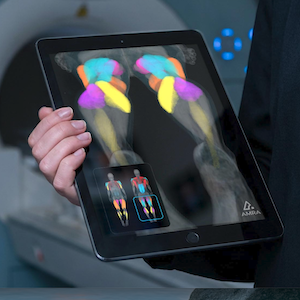
The manuscript, “Muscle MRI as an Imaging Biomarker of Muscle Damage in Patients with Spinal and Bulbar Muscular Atrophy,” highlights how MRI-based muscle composition biomarkers can provide sensitive and objective measures of disease-related change over time. With AMRA Researcher, the study evaluated 25 participants with SBMA to investigate the ability of fat-referenced MRI to assess changes in muscle composition. Using quantitative whole-body MRI, researchers measured longitudinal changes in muscle composition and examined their relationship to established clinical assessments of disease severity and function.
MRI Helps Detect Changes
The findings demonstrated that MRI-derived measures were able to detect significant changes in muscle composition over a 12-month period, underscoring their responsiveness to muscle changes related to progression of SBMA. In addition, baseline MRI measures were correlated with established clinical outcomes, including the Spinal and Bulbar Muscular Atrophy Functional Rating Scale (SBMAFRS) and the 2-Minute Walk Test. These baseline correlations suggest that quantitative muscle imaging may be relevant in SBMA, but additional studies are needed to further characterize the relationship between MRI measures and clinical outcomes.
These results add to a growing body of evidence supporting the use of quantitative MRI as a potential biomarker in neuromuscular disease research. Detecting disease progression in rare neuromuscular disorders can be challenging due to disease heterogeneity, slow progression rates, and limitations associated with traditional functional assessments. Sensitive imaging biomarkers capable of capturing subtle changes in muscle composition may help researchers better understand disease biology, evaluate therapeutic interventions, and improve endpoint selection for clinical trials.
Publication of this work in Neurology expands the growing evidence base for quantitative whole-body MRI beyond previously studied neuromuscular diseases and highlights the potential for additional studies to be conducted utilizing these MRI-based measures within SBMA. As interest continues to grow in the development of therapies for rare neuromuscular disorders, standardized imaging biomarkers have the potential to provide researchers and sponsors with more objective and reproducible measures of disease progression. Recently, AMRA has worked extensively in the neuromuscular disease research space, both in rapidly and slowly progressing neuromuscular diseases as well as inflammatory myopathies (FSHD, DMD, sIBM).
You can find the full manuscript in the most recent issue of Neurology.


 October 22, 2026