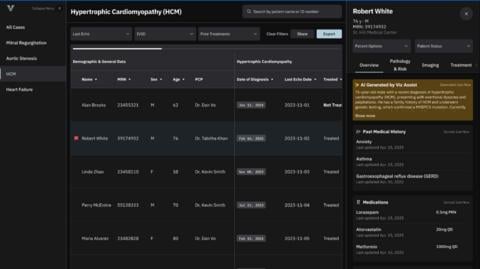
Viz Assist incorporates inputs from ambient listening and the EHR to create a generative AI summary of the patient (Photo: Viz.ai)
Oct. 20, 2025 — Viz.ai has launched of Viz Assist, a suite of autonomous AI agents that significantly enhance how care teams identify, prioritize, and act on critical patient data.1 Viz Assist marks a major step forward in Viz.ai’s mission to use technology to reduce time to treatment and improve patient outcomes.
Viz Assist incorporates inputs from ambient listening and the electronic health record (EHR) to create a generative AI summary of the patient, combining this with Viz.ai’s FDA-cleared imaging AI algorithms to provide a near complete picture of the patient. Acting as virtual team members, Viz Assist AI agents can then deliver the right clinical insights at the right time, enabling faster interventions, more coordinated care, and better outcomes.2 With Viz Assist, hospitals and health systems can move beyond manual mining of EHR data, static tools and reactive alerts, and instead benefit from intelligent agents that constantly scan for clinical signals, reduce cognitive burden,1 and help clinicians focus on the patient. Importantly, Viz Assist aims to streamline clinical documentation and, over time, expand to delivering coding recommendations powered by multimodal data—integrating imaging, ambient listening, and EHR insights. With Viz.ai, more patients get treated, doctors have a lower administrative burden and administrators benefit from more complete documentation2 leading to appropriate reimbursement and operational efficiency for health systems.
“Viz Assist brings us closer to the future of care we’ve always envisioned—one where AI works alongside clinicians, not in place of them,” said Andrew M. Ibrahim, MD, MSc, Chief Clinical Officer at Viz.ai. “These agents don’t just detect problems, they also anticipate needs, curate the essential details, and help care teams act faster and with greater confidence.3 It’s like having a trusted clinical teammate who never sleeps. I am confident this will help bring joy back to medicine.”
Viz Assist enables care teams to act faster by identifying high-risk patients, pulling key details from the EHR, surfacing relevant imaging, and delivering prioritized insights to the appropriate clinicians. Designed to function across multiple hospitals and EHR systems, the agents provide real-time updates to clinical team members wherever they are. This consolidated view helps reduce the need to manually gather information from disparate platforms, easing cognitive burden and supporting faster, more confident decision-making. The agents operate in the background and are designed to complement, not replace, clinical expertise—offering trusted, guideline-based recommendations.
To learn more about Viz Assist, watch the demo video or visit viz.ai/viz-assist.
1 Baker C, Taussky P, et al. How an Artificial Intelligence Application Is Changing Communication in Acute Stroke Intervention. Journal of Neurosurgery. 2023;139(3):912–920. doi:10.3171/2022.11.JNS221259
2 Hassan AE, Ringheanu VM, Preston L, et al. Artificial Intelligence–Parallel Stroke Workflow Tool Improves Reperfusion Rates and Door-In to Puncture Interval. Stroke: Vascular and Interventional Neurology. 2022;2:e000224. doi:10.1161/SVIN.121.000224
3 Elijovich L, et al. Automated Emergent Large Vessel Occlusion Detection by Artificial Intelligence Improves Stroke Workflow in a Hub-and-Spoke Stroke System of Care. J NeuroInterv Surg. 2021;13(10):911-916. doi:10.1136/neurintsurg-2021-017714

 October 08, 2026