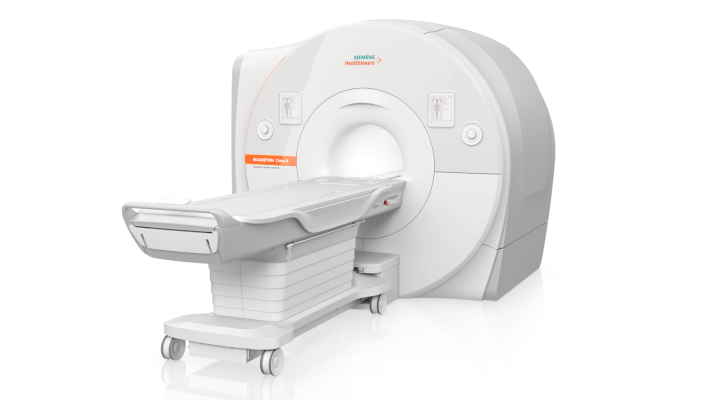
January 4, 2024 — Siemens Healthineers announced the Food and Drug Administration clearance of the Magnetom Cima.X 3 Tesla (3T) magnetic resonance imaging whole-body scanner. It possesses the strongest-ever gradient system for a clinically released whole-body MR scanner, making smaller structures in the body visible, and capturing images faster than previous MR scanners. Additionally, the Magnetom Cima.X has new features designed to enhance scientific research and overcome key imaging challenges in the visualization of cancer and other diseases.
At the heart of the Magnetom Cima.X are its industry-best Gemini Gradients. These gradients have an amplitude of 200 mT/m and a slew rate of 200 T/m/s. At 2.5 times higher than the strongest whole-body MR gradients currently available from Siemens Healthineers, they represent the strongest gradient system of any clinically available whole-body MR scanner. This high gradient level can help clinicians better study neurodegenerative diseases by increasing the visibility of microstructures that cannot be seen clearly with traditional MR scans. That same high level of gradient support can be leveraged across the body.
“With the FDA clearance of the Magnetom Cima.X, Siemens Healthineers proudly offers the scientific and medical communities a whole-body 3T MR scanner that can deliver penetrating new insights into oncologic, cardiac, and neurodegenerative disease,” said Katie Grant, vice president of magnetic resonance at Siemens Healthineers North America.
New standard features on the Magnetom Cima.X can potentially help the research community address key hurdles related to imaging disease states. The new Physiologging feature provides precise, time-stamped physiological data from the patient, including heart and respiratory rates, while performing functional brain imaging. Previously, that physiological data could not be tagged to specific time points in the imaging chain and had to be estimated by the clinician. With Physiologging’s time-synched sensor data, clinicans can better determine, for example, whether brain activation is compromised by a patient’s respiratory activity. The new Open Recon platform enables clinicians to run custom algorithms for image reconstructions directly on the scanner, which functions as the computing platform. The result is immediate reconstruction of MR images. Traditionally, clinicians have needed to use a separate reconstruction platform for research purposes. Open Recon also enables seamless data-sharing between MR scanners and institutions to facilitate research.
Several key differentiating features found previously on other Siemens Healthineers MR scanners are also available on the Magnetom Cima.X and enhance clinical performance. BioMatrix technology automatically adjusts for user variability as well as anatomical and physiological differences of patients to reduce repeated scans and increase productivity, improving MR’s cost efficiency. Deep Resolve reconstruction technology powered by artificial intelligence accelerates MR scans, by up to 70 percent in the case of brain scans, to boost workflow efficiency while improving the patient experience. The myExam Companion workflow solution incorporates AI to help the radiologic technologist navigate the MR exam and achieve consistent, high-quality results, regardless of user experience level, patient, or throughput rate.
For more information: www.siemens-healthineers.us/cimax

 October 08, 2026