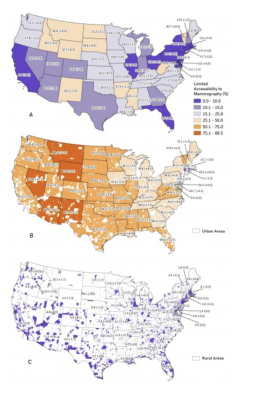
Travel Time for Breast Cancer Screening Remains Long for Many Women in the U.S., New Study Shows. Credit: American Cancer Society
December 19, 2022 — A new study led by researchers at the American Cancer Society (ACS) shows travel time to the nearest mammography facility is long for a considerable proportion of women in the United States, particularly affecting more than 50% of women in rural areas in 28 states. This poor geographic accessibility was associated with a lower number of women getting important breast cancer screening. The study was published today in the Journal of the National Cancer Institute (JNCI).
“Our findings are concerning. Mammography is widely available in the United States, but barriers, such as long drive times, are likely influencing a woman’s decision to get screened,” said Dr. Daniel Wiese, senior scientist, cancer disparity research at the American Cancer Society and lead author of the study. “We need to move forward on programs to remove these barriers so women can access this potentially life-saving screening.”
For the study, researchers obtained mammography location data in the contiguous U.S. (District of Columbia and all states except Alaska and Hawaii) in 2006 and 2022 by census tract (73,718) from the U.S. Food and Drug Administration. Scientists estimated the number and proportion of women aged 45-84 years who had limited travel-time-based geographic accessibility (drive time greater than 20 minutes) to the nearest mammography facility by urban-rural status and state from 2006 to 2022. Researchers then evaluated associations between limited accessibility and breast cancer screening prevalence by state.
The results showed, nationwide, the proportion of women with limited accessibility to mammography remains high. This proportion did not substantially change from 2006 (12.7%) to 2022 (12.2%), however, because of population growth, the estimated number of women with limited accessibility increased from 7.5 million in 2006 to 8.2 million in 2022. In 10 states, the data showed more than 26% of women had limited accessibility to mammography, primarily in the Rocky Mountains and the South regions. Except for a few states in the New England and Mid-Atlantic regions, limited accessibility to mammography was substantial in rural areas (greater than 50% in 28 states), with highest proportions in the Rocky Mountains region. In urban areas, this proportion was less than 5.0% in 35 states. The largest improvements were in South Dakota and Mississippi, where limited accessibility declined by 5.1% and 4.8%, respectively.
“The simple answer would be to open more breast cancer screening facilities in sparsely populated areas, but this can be economically and logistically challenging,” Wiese added. “Providing transportation or promoting the use of mobile screening units may be alternative actions, although further research is needed to improve the effectiveness of mobile screening units in increasing participation in breast cancer screening in rural areas.” Dr. Farhad Islami, senior scientific director, cancer disparity research at the American Cancer Society also participated in this study.
For more information: www.cancer.org
Related Content:
High Deductible Leads Women to Skip Testing after Abnormal Mammogram
RSNA Launches Screening Mammography Breast Cancer Detection AI Challenge
Revolutionizing Women’s Health with One-day Diagnosis
Single vs. Multiple Architectural Distortion on Digital Breast Tomosynthesis
Today's Mammography Advancements
Digital Breast Tomosynthesis Spot Compression Clarifies Ambiguous Findings
AI DBT Impact on Mammography Post-breast Therapy
ImageCare Centers Unveils PINK Better Mammo Service Featuring Profound AI
Radiologist Fatigue, Experience Affect Breast Imaging Call Backs
Fewer Breast Cancer Cases Between Screening Rounds with 3-D Mammography
Study Finds Racial Disparities in Access to New Mammography Technology
 October 09, 2026