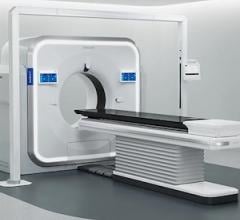
The InSightec ExAblate focused ultrasound system developed to treat essential tremor.
August 24, 2021 — Researchers are bringing the use of acoustic waves to target and destroy cancerous tumors closer to reality.
While doctors have used low-intensity ultrasound as a medical imaging tool since the 1950s, experts at the University of Waterloo are using and extending models that help capture how high-intensity focused ultrasound (HIFU) can work on a cellular level.
Led by Siv Sivaloganathan, an applied mathematician and researcher with the Centre for Math Medicine at the Fields Institute, the study found by running mathematical models in computer simulations that fundamental problems in the technology can be solved without any risk to actual patients.
Sivaloganathan, together with his graduate students June Murley, Kevin Jiang and postdoctoral fellow Maryam Ghasemi, creates the mathematical models used by engineers and doctors to put HIFU into practice. He said his colleagues in other fields are interested in the same problems, “but we’re coming at this from different directions”.
“My side of it is to use mathematics and computer simulations to develop a solid model that others can take and use in labs or clinical settings. And although the models are not nearly as complex as human organs and tissue, the simulations give a huge head start for clinical trials.”
One of the obstacles that Sivaloganathan is currently working to overcome is that in targeting cancers, HIFU also poses risks to healthy tissue. When HIFU is being used to destroy tumors or cancerous lesions, the hope is that good tissue won’t be destroyed. The same applies when focusing the intense acoustic waves on a tumour on the bone where lots of heat energy gets released. Sivaloganathan and his colleagues are working to understand how the heat dissipates and if it damages the bone marrow.
Other researchers working with Sivaloganathan include engineers, who are building the physical technology, and medical doctors, in particular, James Drake, chief surgeon at Hospital for Sick Children, looking at the practical application of HIFU in clinical settings.
Sivaloganathan believes HIFU will make significant changes in cancer treatments and other medical procedures and treatments. HIFU is already finding practical application in the treatment of some prostate cancers.
“It’s an area that I think is going to take center stage in clinical medicine,” he said. “It doesn’t have the negative side effects of radiation therapy or chemotherapy. There are no side effects other than the effect of heat, which we are working on right now. It also has applications as a new way to break up blood clots and even to administer drugs.”
Sivaloganathan’s new research paper on math modelling for HIFU, “Dimension estimate of uniform attractor for a model of high intensity focussed ultrasound-induced thermotherapy,” with co-authors Messoud Efendiyev and June Murley, was recently published in the Bulletin of Mathematical Biology.
For more information: medicalxpress.com/
Related High-intensity Focused Ultrasound Content:
High-intensity Focused Ultrasound Offers New Opportunities
Ultrasound Technique Treats Prostate Cancer with Minimal Side Effects
Destroying Cancer Cells with Non-surgical Ultrasound Treatment
First U.S. Study Shows Promising Outcomes for High-intensity Focused Ultrasound for Prostate Cancer

 October 08, 2026