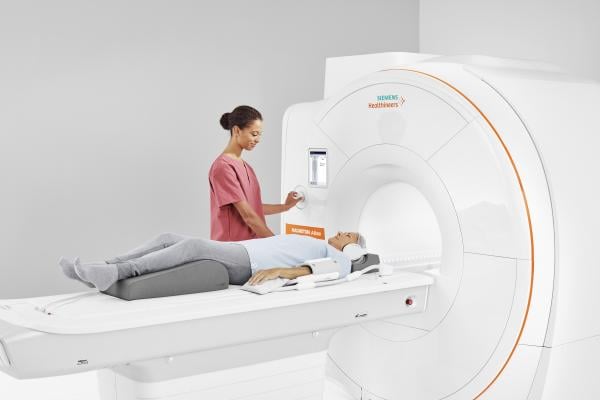
Image courtesy of Siemens Healthineers
A new report, Magnetic Resonance Imaging Equipment Market Size, Share & Industry Analysis, conducted by Fortune Business Insights, states that the magnetic resonance imaging (MRI) equipment market reached $7.24 billion in 2019 and is projected to reach $11.36 billion by 2027. This is a compound annual growth rate (CAGR) of 6.2 percent during the forecast period.
Driving this growth is the rising incidence of cancer and heart disease. In 2020, the American Cancer Society estimates that approximately 1.8 million new cases of cancer will be diagnosed in the U.S. Many of these cancer types can be detected and managed using MRI technology. MRI also can provide high quality images of areas that are specifically affected by strokes. Centers for Disease Control and Prevention (CDC) states that in the U.S., more than 795,000 people suffer from strokes every year.
Technology Driving MRI
Driving this growth is advancements in diagnostic techniques, including visualization software. For example, in August the U.S. Food and Drug Administration (FDA) cleared two Siemens Healthineers artificial intelligence-based software assistants in the AI-Rad Companion family. Both new software help free radiologists from routine activities during MRI exams. The AI-Rad Companion Brain MR for Morphometry Analysis automatically segments the brain in MRI images, measures brain volume and marks volume deviations. The AI-Rad Companion Prostate MR for Biopsy Support automatically segments the prostate on MRI images and enables radiologists to mark lesions, facilitating targeted prostate biopsies.
“These new AI-Rad Companion applications for MR exams in the brain and prostate regions will help physicians manage their workloads and achieve a patient-focused decision-making process to increase efficiency and improve the quality of care,” said Peter Shen, vice president of Innovation and Digital Business at Siemens Healthineers North America, in a statement.
Global Clinical Research
At the recent virtual International Society for Magnetic Resonance in Medicine (ISMRM) 2020 meeting in August, Philips and University Medical Center (UMC) Utrecht, Netherlands, kicked off a research partnership to advance precision diagnosis through breakthrough quantitative MRI technology. The exclusive, multi-year research partnership will establish a global clinical research network with the aim of fully commercializing the technology, which has initially been developed at UMC Utrecht.
According to Philips, MR-STAT is a major shift in MRI, relying on a new, smart acquisition scheme and machine-assisted reconstruction. It delivers multiple quantitative MR parameters in a single fast scan, and represents a significant advance in MR tissue classification, fueling big data algorithms and AI-enabled integrated diagnostic solutions.
“At Philips, we’re focused on supporting healthcare providers to realize first-time-right diagnosis through clinically relevant and intelligent diagnostics,” said Joland Rutgers, research and development leader for MR at Philips, in a statement. “With this fast quantitative and single acquisition technology, enhanced with AI, MR-STAT will play a pivotal role in delivering the best diagnostic outcome at an affordable cost, benefitting both healthcare providers and their patients.”
Deep Learning Algorithms
Continuing to expand access to its new Deep Learning Reconstruction (DLR) technology, Canon received 510(k) clearance on its Advanced intelligent Clear-IQ Engine (AiCE) for the Vantage Orian 1.5T MR system. This technology, which is also available on the Vantage Galan 3.0T MR system and across a majority of Canon Medical’s CT product portfolio, uses a deep learning algorithm to differentiate true signal from noise so it can suppress noise while enhancing signal, forging a new frontier for image reconstruction, according to the company.
“The Vantage Orian was designed to increase productivity while ensuring patient comfort and delivering uncompromised clinical confidence,” said Jonathan Furuyama, managing director, MR business unit, Canon Medical Systems USA Inc. “Now with the addition of AiCE, we’re elevating MR imaging capabilities for our customers by bringing the power of AI to routine imaging, allowing them to use techniques that weren’t clinically practical before.”
In May, GE Healthcare announced U.S. FDA 510(k) clearance of another deep learning-based neural network, AIR Recon DL. This technology helps improve the patient experience through shorter scan times while also increasing diagnostic confidence with better image quality across all anatomies. developed on the Edison intelligence platform, AIR Recon DL seamlessly integrates into the clinical workflow to generate AIR Recon DL images in real-time at the operator’s console. AIR Recon DL eliminates the need for clinicians to choose between image quality and scan time.
“In our experience, [AIR Recon DL] enables us to back off on the number of [signal] averages or achieve a higher matrix, to either save on scan time or achieve a higher resolution image,” said Hollis Potter, M.D., chairman of the department of radiology and imaging at Hospital for Special Surgery in New York City.

 October 08, 2026