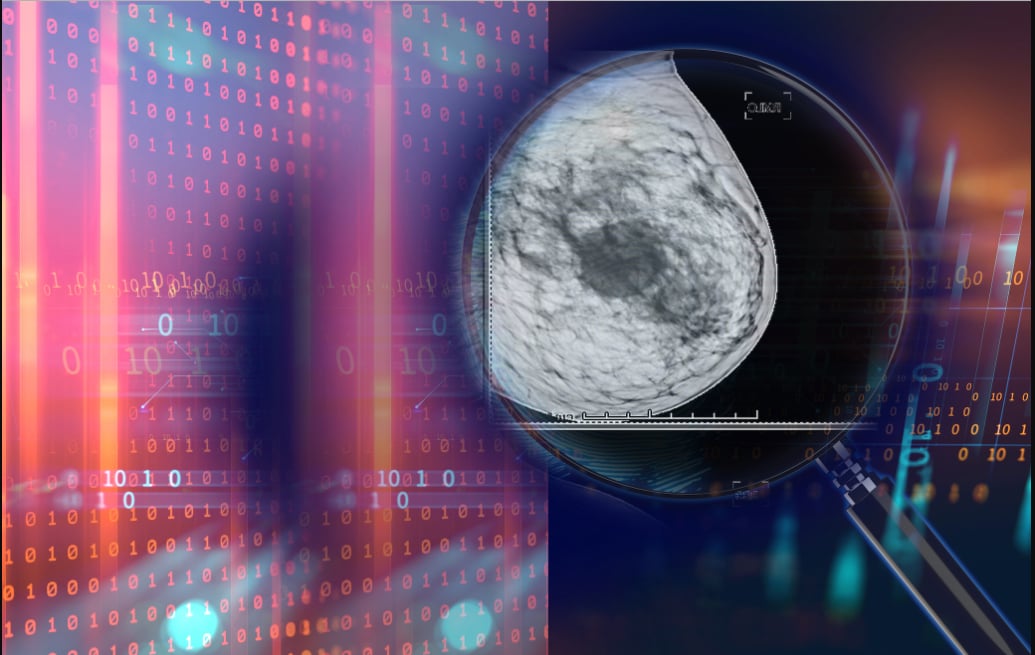
A recent study earlier this year in the journal Nature, which included researchers from Google Health London, demonstrated that artificial intelligence (AI) technology outperformed radiologists in diagnosing breast cancer on mammograms. This study is the latest to fuel ongoing speculation in the radiology industry that AI could potentially replace radiologists. However, this notion is simply sensational.
Consider the invention of autopilot. Despite its existence, passengers still rely on pilots, in conjunction with autopilot technology, to travel. Similarly, radiologists can combine their years of medical knowledge and personal patient relationships with AI technology to improve the patient and clinician experience. To examine this in greater detail, consider the scenarios in which AI is making, or can make, a positive impact.
Identifying Dense Breast Tissue
Measuring a woman’s breast density is critical in assessing her risk for developing breast cancer, as women with very dense breasts are four to five times more likely to develop breast cancer than women with less dense breasts.1,2 However, as radiologists know, very dense breast tissue can create a “masking effect” on a traditional 2-D image, since the glandular tissue color matches that of cancer. As a result, a woman’s breast density classification can influence the type of breast screening exam she should get. For example, digital breast tomosynthesis (DBT) technology has proven as superior for all women, including those with dense breasts.
Categorizing density, though, can traditionally be a subjective process — radiologists must manually view the breast images and make a determination, and in some cases two radiologists may disagree on a classification. This is where AI technology can make a positive impact. Through a collection of images in a database and consistent algorithms, AI technology can help unify breast density classification, especially for images teetering between a B and C BI-RADS score.
While AI technology may offer the potential to provide more consistent BI-RAD scores, the role of the radiologist is still very necessary — it’s the radiologist who would know the patient’s full profile that could impact clinical care. For example, this can include other risk factors their patient may have, such as family history of breast cancer, to personal beliefs about various screening options and beyond — all of which are external factors that could influence how to manage a particular patient’s journey of care.
Improving Radiology Workflow
In addition to helping assist with breast density classification, AI technology can also help improve workflow for radiologists which can, in turn, impact patient care. Although it is clinically proven to detect more invasive breast cancers, DBT technology produces a much larger amount of data and larger data files compared to 2-D mammography, creating workflow challenges for radiologists. However, AI technology now exists that can help reduce reading time for radiologists by identifying the critical parts of 3-D data worth preserving. The technology can then cut down on the number of images to read while maintaining image quality. The AI technology does not take over the radiologists’ entire role of reading the images and providing a diagnosis to patients — it simply calls to their attention the higher risk images and cases that require urgent attention, allowing radiologists to prioritize cases in need of more serious and immediate scrutiny.
There are many more challenges that radiologists face today in which AI technology can potentially make an impact in the future. For example — the length of time between a woman’s screening and the delivery of her results could use improvement, especially since that waiting period can elicit very high emotions. The important thing to realize for now, though, is that AI technology plays an important and positive role in radiology today, and the best outcomes will occur when radiologists and AI technology are not mutually exclusive but rather work in practice together.
 Samir Parikh is the global vice president of research and development for Hologic. In this role, he is responsible for leading and driving innovative advanced solutions across the continuum of care to drive sustainable growth of the breast and skeletal health division.
References:
1. Boyd NF, Guo H, Martin LJ, et al. Mammographic density and the risk and detection of breast cancer. N Engl J Med. 356(3):227-36, 2007.
2. Yaghjyan L, Colditz GA, Collins LC, et al. Mammographic breast density and subsequent risk of breast cancer in postmenopausal women according to tumor characteristics. J Natl Cancer Inst. 103(15):1179-89, 2011.
 October 09, 2026