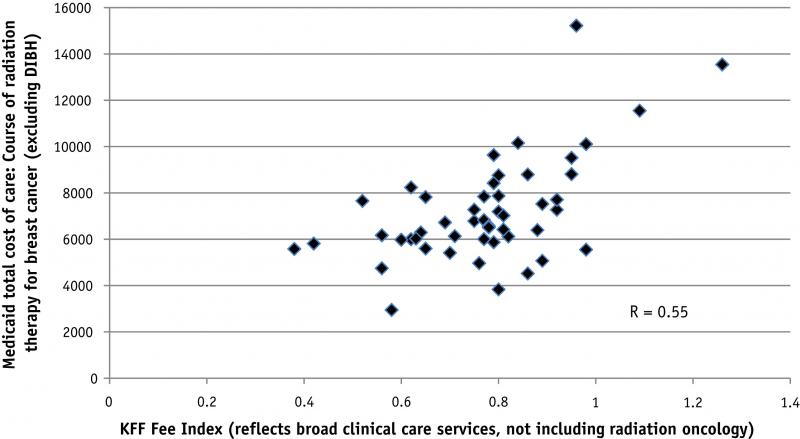
Fig. 1: Comparison of state Medicaid fees for radiation oncology services for breast cancer and nonradiation oncology services per the Kaiser Family Foundation Index. (Agarwal et al, Red Journal, 2019) Credit: Elsevier
April 22, 2019 — A new study finds wide state-by-state variations in Medicaid reimbursements to physicians who treat cancer patients with radiation therapies. These differences could compound existing disparities in access to healthcare in rural communities, which tend to have higher Medicaid coverage rates than metropolitan areas. The study is available for free access through April 24 in the International Journal of Radiation Oncology • Biology • Physics (Red Journal), the flagship scientific journal of the American Society for Radiation Oncology (ASTRO).1
“Roughly 66 million low-income Americans are enrolled in Medicaid, and we know from previous studies that these patients face disproportionate difficulty and delays getting the care they need,” said Ankit Agarwal, M.D., MBA, first author of the study and a radiation oncology resident physician at the University of North Carolina at Chapel Hill. “With cancer care, timely treatment matters, and states that under-compensate for radiation therapy likely undermine patients’ health outcomes.”
For the analysis, researchers examined 2017 Medicaid fee schedules from 48 states and the District of Columbia2. Key findings included:
-
Fivefold difference in reimbursement rates: The average reimbursement for standard-of-care radiation therapy to treat breast cancer3 ranged from a low of $2,945 in New Hampshire, to a high of $15,218 in Delaware, with an overall average of $7,233 for an entire episode of care.
-
Radiation oncology disproportionately affected: The variation in radiation therapy payments outpaces the differences seen with other Medicaid reimbursements. Analysis of the Kaiser Family Foundation Medicaid-to-Medicare fee index for general medical services found that reimbursement ratios ranged from a low of 0.38 in Rhode Island to a high of 1.26 in Alaska — a threefold difference. By comparison, the authors’ index of radiation oncology payments showed a fivefold difference.
“Clinics that provide radiation therapy also have expensive fixed costs to purchase and maintain the equipment used for treatments. Inadequate and disproportionate Medicaid reimbursement rates — which already fall below comparable Medicare rates — can negatively impact the viability of facilities, especially in rural and private practice settings. Any reduction in the number of facilities in these areas can limit or remove patient access to these life-saving medical services,” explained Agarwal.
“Greater stability and fairness in Medicaid compensation would help stabilize access for Medicaid patients and make it more financially feasible for the physicians who care for them, especially in rural communities and those with fewer physicians overall. If left unaddressed, however, the disparity could aggravate the growing maldistribution of radiation oncologists in rural and urban communities — and place low-income patients in rural communities at even greater threat.”
For more information: www.redjournal.org
References
1. Agarwal A., Peterson J., Hoyle L., et al. Variations in Medicaid Payment Rates for Radiation Oncology. International Journal of Radiation Oncology • Biology • Physics, published online March 31, 2019. DOI: org/10.1016/j.ijrobp.2019.02.031
2. Findings are based on Medicaid fee schedules from the fourth quarter of 2017, obtained from the state Medicaid websites or departments. Two states were not included in the analysis: Tennessee does not follow a Medicaid fee-for-service model, and Illinois’ fee schedule was incomplete.
3. The reference case was a patient who received hypofractionated radiation therapy for breast cancer, using the deep inspiration breast hold (DIBH) technique and a radiation boost to the tumor bed. This clinical scenario is one of the most common in radiation oncology; Agarwal also noted that reimbursement for this treatment scenario is generally reflective of how radiation oncology is reimbursed for other commonly-treated sites.

 October 01, 2026