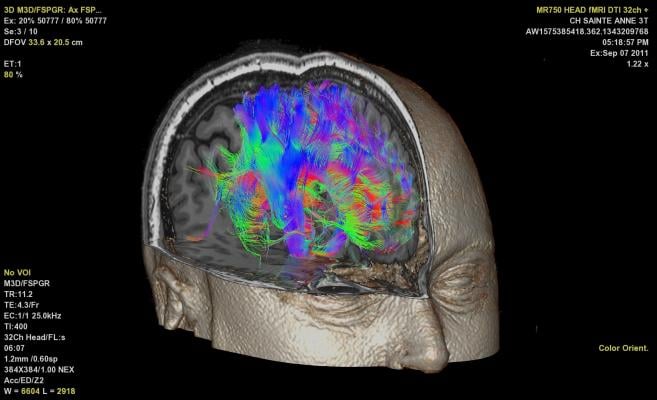
January 11, 2019 — An interdisciplinary research team led by scientists from the National University of Singapore (NUS) has successfully employed machine learning to uncover new insights into the cellular architecture of the human brain.
The team demonstrated an approach that automatically estimates parameters of the brain using data collected from functional magnetic resonance imaging (fMRI), enabling neuroscientists to infer the cellular properties of different brain regions without probing the brain using surgical means. This approach could potentially be used to assess treatment of neurological disorders, and to develop new therapies.
“The underlying pathways of many diseases occur at the cellular level, and many pharmaceuticals operate at the microscale level. To know what really happens at the innermost levels of the human brain, it is crucial for us to develop methods that can delve into the depths of the brain non-invasively,” said team leader Assistant Prof. Thomas Yeo, who is from the Singapore Institute for Neurotechnology (SINAPSE) at NUS, and the A*STAR-NUS Clinical Imaging Research Centre (CIRC).
The new study, conducted in collaboration with researchers from the Netherlands and Spain was first reported online in scientific journal Science Advances on Jan. 9, 2019.1
Unravelling the complexity of the human brain
The brain is the most intricate organ of the human body, and it is made up of 100 billion nerve cells that are in turn connected to around 1,000 others. Any damage or disease affecting even the smallest part of the brain could lead to severe impairment.
Currently, most human brain studies are limited to non-invasive approaches, such as magnetic resonance imaging (MRI). This limits the examination of the human brain at the cellular level, which may offer novel insights into the development, and potential treatment, of various neurological diseases.
Different research teams around the world have harnessed biophysical modelling to bridge this gap between non-invasive imaging and cellular understanding of the human brain. The biophysical brain models could be used to simulate brain activity, enabling neuroscientists to gain insights into the brain. However, many of these models rely on overly simplistic assumptions, such as all brain regions have the same cellular properties, which scientists have known to be false for more than 100 years.
Constructing virtual brain models
Yeo and his team worked with researchers from Universitat Pompeu Fabra, Universitat Barcelona and University Medical Center Utrecht to analyze imaging data from 452 participants of the Human Connectome Project. Departing from previous modeling work, they allowed each brain region to have distinct cellular properties and exploited machine learning algorithms to automatically estimate the model parameters.
“Our approach achieves a much better fit with real data. Furthermore, we discovered that the micro-scale model parameters estimated by the machine learning algorithm reflect how the brain processes information,” said Peng Wang, Ph.D., who is the first author of the paper, and had conducted the study when he was a postdoctoral researcher on Yeo’s team.
The research team found that brain regions involved in sensory perception, such as vision, hearing and touch, exhibit cellular properties opposite from brain regions involved in internal thought and memories. The spatial pattern of the human brain’s cellular architecture closely reflects how the brain hierarchically processes information from the surroundings. This form of hierarchical processing is a key feature of both the human brain and recent advances in artificial intelligence.
“Our study suggests that the processing hierarchy of the brain is supported by micro-scale differentiation among its regions, which may provide further clues for breakthroughs in artificial intelligence,” said Yeo, who is also with the Department of Electrical and Computer Engineering at the NUS Faculty of Engineering.
Moving forward, the NUS team plans to apply their approach to examine the brain data of individual participants, to better understand how individual variation in the brain’s cellular architecture may relate to differences in cognitive abilities. The team hopes that these latest results can be a step towards the development of individualized treatment plans with specific drugs or brain stimulation strategies.
For more information: www.advances.sciencemag.org
Reference
1. Wang P., Kong R., Kong X., et al. Inversion of a large-scale circuit model reveals a cortical hierarchy in the dynamic resting human brain. Science Advances, Jan. 9, 2019. DOI: 10.1126/sciadv.aat7854

 October 07, 2026