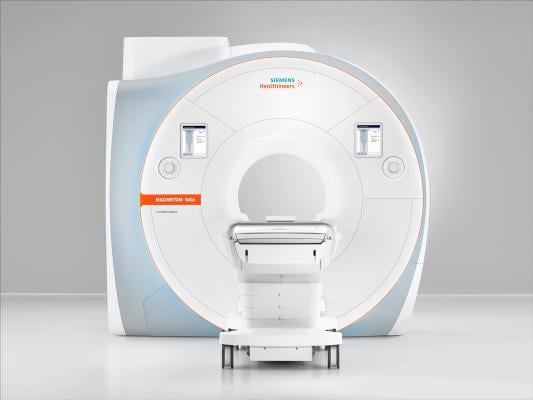
October 9, 2018 — The U.S. Food and Drug Administration (FDA) has cleared the Magnetom Sola, a 1.5 Tesla magnetic resonance imaging (MRI) scanner from Siemens Healthineers that brings Siemens’ BioMatrix technology to the 1.5T market. This technology addresses patient anatomical and physiological differences, as well as differences in how users set up and conduct MRI exams, to increase productivity and decrease rescans for improved efficiency and patient satisfaction.
The Magnetom Sola helps healthcare providers perform a full range of routine and complex MRI exams while accelerating workflow and delivering consistent results across all patient types. BioMatrix Sensors save setup time and inform the correct exam strategy. Respiratory Sensors in the patient table eliminate the need for navigators with respiratory-triggered sequences. A new Kinetic Sensor, an in-bore camera system, enables technologists to visually monitor the patient’s face. BioMatrix Tuners improve the quality and reproducibility of head, neck and spine imaging using distortion-mitigating software and hardware. BioMatrix Interfaces utilize artificial intelligence (AI) and body models to expedite patient positioning and deliver consistent, reproducible results.
The scanner architecture offers extremely high performance in an open, 70-cm bore. Larger body regions can be covered in one step with a full 50x50x50 cm field of view. Ultra-lightweight, anatomy-adaptive coils improve patient comfort while delivering high signal-to-noise ratio with up to 204 RF channels.
New software enables faster scanning to benefit patients and the facility. Multi-Slice TSE reduces routine musculoskeletal scan times by up to 46 percent. Compressed Sensing not only makes cardiac and dynamic liver exams faster, but also enables imaging of patients who cannot reliably hold their breath.
Combined with Dot workflow engines and Tim 4G technology, the software accelerates scanning from positioning to post-processing with continual quality control of image data. The result is increased productivity and consistency across patients and exams.
A cardiovascular edition of the Magnetom Sola – which includes high-performance hardware and software such as Compressed Sensing Cardiac Cine, MyoMaps and the Cardiac Dot engine – is also available.
For more information: www.usa.healthcare.siemens.com

 October 07, 2026