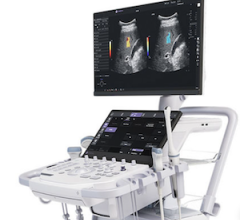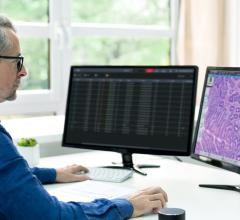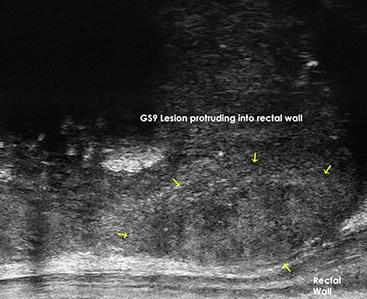
September 19, 2018 — Exact Imaging, makers of the ExactVu micro-ultrasound platform, has partnered with U.K.-based Cambridge Consultants to improve the way prostate cancer is visualized and detected. Cambridge Consultants is applying deep learning, also known as artificial intelligence (AI), to high-resolution micro-ultrasound imaging to identify potential suspicious regions of tissue and inform urologists who may want to consider this additional data in their biopsy protocol. Early results show real promise, according to both companies.
Prostate cancer is the second most common cause of cancer death in men in both the U.S. and the U.K. There is an urgent need for improved accuracy in the detection and diagnosis of aggressive prostate cancers. The current standard-of-care ultrasound, which guides prostatic needle biopsies that help to diagnose prostate cancer, yields a 30 percent false negative rate as the resolution of the ultrasound systems is insufficient to differentiate suspicious regions. As such, the prostate biopsies are usually delivered in a systematic, “blind” pattern.1
The ExactVu micro-ultrasound platform allows urologists to harness “micro”-ultrasound’s near microscopic resolution in order to visualize suspicious regions and actually target their biopsies to those regions. Operating at 29 MHz, the micro-ultrasound provides a 300 percent improvement in resolution over conventional ultrasound.
With Cambridge Consultants’ AI tools being able to interrogate the full ultrasound data set when correlated to pathology, the analysis should deliver improved accuracy and better characterization of suspicious regions. The machine learning approach being applied is faster and less computationally intensive than traditional statistical approaches; this may ultimately form the backbone of a commercially-viable software application. Early results from proof of concept testing show significant promise, even with relatively limited data sets, according to the company.
The current work on prostate cancer is the latest output from Cambridge Consultants’ Digital Greenhouse2, an experimental environment where data scientists and engineers explore and develop machine learning and deep learning techniques. The Digital Greenhouse aims to ensure that deep learning is potent beyond the huge online datasets that have powered advances to date. Recent work has focused on applying deep learning in areas where massive datasets are unavailable. In the case of its work on prostate cancer, data was available for hundreds of patients.
For more information: www.exactimaging.com, www.cambridgeconsultants.com
References

 October 21, 2026