News | Neuro Imaging | June 12, 2018

UCLA study uses Neuroreader software to measure brain shrinkage patterns on MRI scans

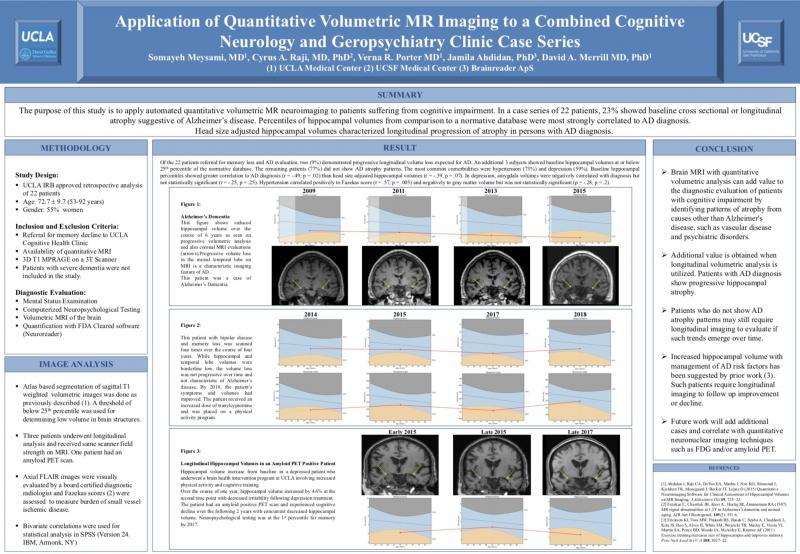
Reduced hippocampal volume on MRI

This figure shows reduced hippocampal volume over the course of 6 years as seen on progressive volumetric analysis and also coronal MRI evaluations (arrows).Progressive volume loss in the mesial temporal lobe on MRI is a characteristic imaging feature of AD. This patient was a case of Alzheimer’s Dementia.


June 12, 2018 — According to a UCLA Medical Center study, a new technology shows the potential to help doctors better determine when memory loss is caused by treatable issues other than Alzheimer’s Disease. The study was presented at the 2018 American Academy of Neurology Conference, April 21-27 in Los Angeles.

Alzheimer’s is the most common cause of memory problems in the elderly, but there are several treatable problems with similar symptoms, including vascular diseases such as hypertension, alcohol use and psychiatric disorders.

The new technology was the U.S. Food and Drug Administration (FDA)-cleared Neuroreader volumetric software. The software was applied to traditional magnetic resonance imaging (MRI) scans to analyze 22 patients, and found that only five showed brain shrinkage patterns characteristic of Alzheimer’s. The majority of the remaining cases were a combination of other causes, such as bipolar disorder and vascular disease.

For more information: www.brainreader.net

Related Content

News | Radiology Imaging

Feb. 12, 2026 — Siemens Healthineers and Mayo Clinic are expanding their strategic collaboration to enhance patient care ...

Time February 13, 2026
arrow
News | ARRS

Feb. 11, 2026 —The American Roentgen Ray Society (ARRS) has announced the following radiologists, as well as their ...

Time February 13, 2026
arrow
News | Magnetic Resonance Imaging (MRI)

Feb. 6, 2026 — A state-of-the-art intraoperative MRI (iMRI) has arrived at the University of Chicago Medicine, one of ...

Time February 06, 2026
arrow
News | Magnetic Resonance Imaging (MRI)

Jan. 27, 2026 — Hyperfine has announced results from the largest data set to date evaluating stroke detection with its ...

Time January 28, 2026
arrow
News | Radiology Education

Jan. 22, 2026—The American Roentgen Ray Society (ARRS) will host a live virtual symposium, "Medical Imaging for ...

Time January 28, 2026
arrow
News | Radiology Imaging

Jan.26, 2026 — SimonMed Imaging has unveiled an updated brand and the launch of SimonMed Longevity, a new division ...

Time January 27, 2026
arrow
News | PET Imaging

Jan. 26, 2026 — Nuclidium, a clinical-stage radiopharmaceutical company developing a proprietary copper-based ...

Time January 27, 2026
arrow
News | Magnetic Resonance Imaging (MRI)

Jan. 20, 2026 — Hyperfine, the developer of the first FDA-cleared AI-powered portable MRI system for the brain — the ...

Time January 20, 2026
arrow
News | Stroke

Dec. 12, 2025 — Hyperfine, Inc. has announced that it has received FDA clearance for a new multi-direction diffusion ...

Time December 15, 2025
arrow
News | Artificial Intelligence

Dec. 1, 2025 — Researchers at the University of California, Berkeley and University of California, San Francisco have ...

Time December 10, 2025
arrow
Subscribe Now