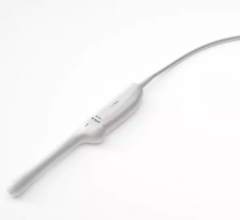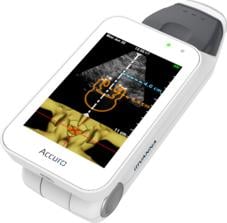
October 9, 2017 — A clinical trial conducted at Stanford University Medical Center published online in Anesthesia & Analgesia proved the accuracy of the Accuro image-guided spinal navigation system in calculating the optimal site and needle depth for epidural anesthesia administration. The research is the latest in a series of studies supporting the efficacy of Rivanna’s handheld ultrasound system with proprietary pattern recognition software, which identifies spinal landmarks and provides automated epidural placement guidance. The Accuro platform also has application in a range of additional medical procedures that benefit from visualization of targeted anatomical areas.
In the clinical trial, Rivanna Accuro identified the appropriate epidural injection sites along the lower spine and calculated the depth to the epidural space, a narrow hollow area in the spine. Actual epidural depth was confirmed by measuring needle penetration during successful epidural delivery by anesthesia providers. Accuro predicted this depth within an average of .61 cm.
In addition, Accuro identified the appropriate spinal interspace for needle insertion in 94 percent of patients and enabled 87 percent success in first-attempt epidural administration. The research was conducted under the direction of Brendan Carvalho, M.D., at Stanford Medical Center and led by Katherine Seligman, M.D., currently faculty at the University of New Mexico.
Repeated epidural needle insertions can negatively impact the patient with ongoing headaches, bleeding, back pain and possibly paralysis. Failed epidurals cost the medical system more than $1.5 billion annually.
Ultrasound is the imaging modality of choice for epidurals because most are administered to expectant mothers who must avoid the radiation involved in other imaging procedures.
Significant research shows that ultrasound guidance of epidural and other neuraxial anesthesia significantly improves efficacy and patient safety. However, performing and interpreting ultrasound requires specialized training not typically in the anesthesia provider’s skillset.
Accuro’s SpineNav3D computerized ultrasound image guidance eliminates the steep ultrasound learning curve, making it simple and practical for anesthesiologists and other medical professionals not trained in the modality.
Rivanna Accuro also incorporates BoneEnhance technology, which optimizes the device for visualization of bony spinal anatomy. Accuro delivers a five- to 10-fold increase in bone-to-tissue contrast compared to traditional ultrasound, which is generally preferred for soft tissue imaging. The pocket-sized, wireless device is simple and practical to use in a wide range of settings where traditional large, unwieldy systems can be a problem.
A recent randomized trial at University of Virginia Medical Center found that for residents with prior spinal anesthesia experience, Accuro improved first-attempt needle placement by more than 100 percent in patients with a high body mass index. Appropriate needle placement in these patients is particularly difficult. The average number of needle redirections to achieve placement using Accuro was almost half that of the same sub-group using conventional placement methods.
For more information: www.rivannamedical.com

 October 07, 2026