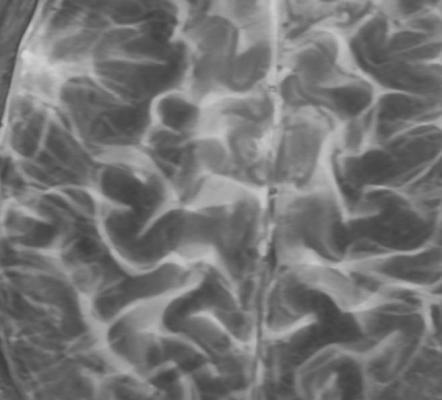
March 31, 2016 — New research suggests that looking at structures in the right side of the brain may help predict who will better recover from language problems after a stroke. The study is published in Neurology, a medical journal of the American Academy of Neurology (AAN).
The brain is divided into two hemispheres, the right and the left. The left side is dominant in language and speech-motor functions in most people, so when it is damaged by stroke, it can lead to aphasia. Aphasia is difficulty speaking, naming, repeating and understanding language.
“Aphasia is a common and devastating symptom for people who have strokes on the left side of the brain,” said study author Gottfried Schlaug, M.D., Ph.D., of Harvard Medical School in Boston, and a member of the AAN. “Although many people recover to some degree, many people never make a full recovery, even after intense speech therapy.”
The study involved 33 people with an average age of 58 years who had a stroke on the left side of the brain, on average about two and a half years prior to undergoing magnetic resonance imaging (MRI) and speech fluency tests. All had aphasia that persisted to different degrees even after their usual speech therapy. Researchers also tested 13 healthy people of similar ages who had never had a stroke.
Both the healthy participants and the stroke group had brain scans employing a special MRI technique that allowed them to examine brain tissue integrity and connectivity in various regions within the brain. Better structural integrity might suggest better connections among areas of the brain.
They found that patients with aphasia who performed better on the speech-fluency tests were more likely to have higher structural integrity in three areas of the brain than the control group: the right middle temporal gyrus, the right inferior frontal and the right precentral gyrus. Researchers were able to show the contribution of these right hemisphere regions to speech-fluency, since the correlation scores between the amount of injury to the left hemisphere and speech-fluency scores were improved when the right hemisphere information was added to the analysis. (For example, the amount of variance explained went from 50 percent to 62 percent for words per minute as one of two fluency measures when information from the right hemisphere was added to the statistical analysis).
The study suggests that the right side of the brain reorganizes itself to help recover language/speech-motor functions. Because the study only looked at one point in time, it is also possible that those people who recovered better may have had better structural integrity and more connectivity in those right hemisphere areas of the brain before their strokes.
“This study suggests that a well-wired right brain actively supports recovery from aphasia,” said A.M. Barrett, M.D., of the Kessler Foundation in West Orange, N.J., and fellow of the American Academy of Neurology, who wrote a corresponding editorial. “More research is needed to determine if the differences in structural integrity in the right brain are there before a stroke, develop after a stroke or are influenced by some other factor. Eventually it may be possible to develop new targets in the right brain for people with aphasia to be treated with new therapies, such as brain stimulation”
Schlaug also added that melodic intonation therapy, an intonation-based therapy that is geared towards the right hemisphere, may be another possible new treatment target.
The study was supported by the National Institutes of Health, Richard and Rosalyn Slifka Family Fund, Tom and Suzanne McManmon Family Fund, and Mary Crown and William Ellis Fund.
For more information: www.neurology.org

 October 07, 2026