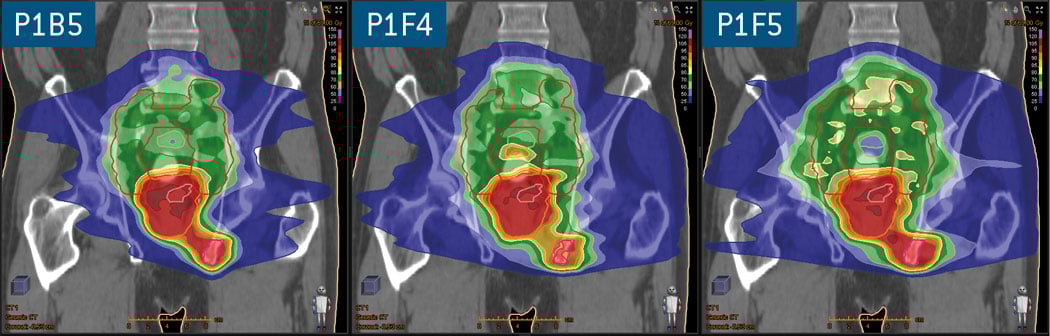
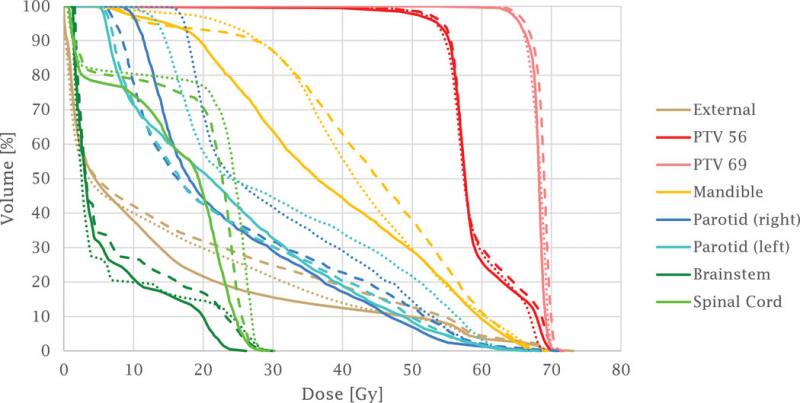
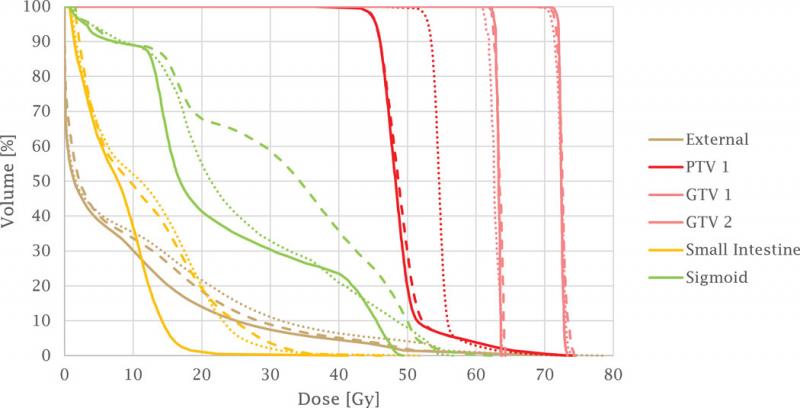
Case one: Three plans and respective DVHs, P1B5 (solid), P1F4 (dashed), P1F5 (dotted)
Plan optimization and dose calculation for complex VMAT plans are computationally challenging tasks. Depending on the efficiency of the TPS implementation, and the hardware on which it runs, calculation times can range from a few minutes to up to more than a half hour. It stands to reason that a dosimetrist equipped with a high performing system should be able to produce plans of higher quality compared to one equipped with a slow system irrespective of his/her experience level. This study aims to measure the effect of planning speed on plan quality.
Setup
20 people with IMRT and/or VMAT planning experience from clinics that use RayStation participated in the study. Two RayStation configurations were used. One was equivalent to the regular RayStation 4.7 and the other was slowed down so that optimizations and dose calculations took 4-5 times longer than usual. Two patient cases were used, one very complex prostate case and one complex head and neck case. For both cases, dual arc VMAT was used. For each case, a scoring system based on the fulfillment of clinical goals had been created and was communicated to the participants. In the first two-hour session, all participants planned the first case. Half of the participants used the fast system and half used the slow system. For the second two-hour session, all participants planned the second case and all changed system speeds. This way, all participants planned both cases and used both systems. The participants were not informed about the nature of the difference between the systems, only that there were two different types.
Main Result
All participants successfully created a plan in the allocated time. In the main analysis, seven users were excluded as they did not compute dose with the clinical dose engine in one or both cases. For the 13 remaining participants, we found that all users scored consistently better when using the fast systems and that the average improvement was 15 points using the above mentioned scoring.
Example Results
Case One. In the images on the left, the plan P1B5 was planned on a fast system and P1F4 and P1F5 on slow systems. P1F4 and P1F5 scored 10.9 and 18.3 points worse than P1B5, making them representative examples of the 15 point average score difference. In general, P1B5 achieved a much better conformity without sacrificing homogeneity.
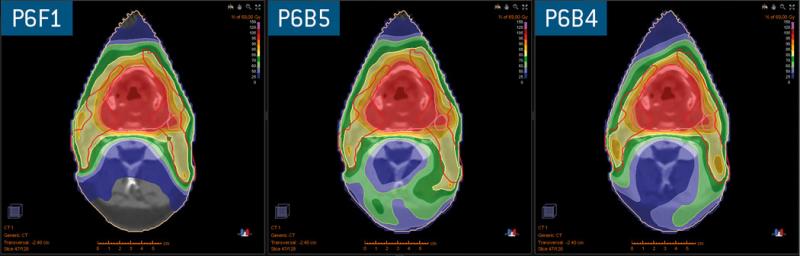
Case Two. In the images above, the plan P6F1 was planned on a fast system and the plans P6B5 and P6B4 on slow systems. P6B5 and P6B4 scored 10.6 and 15.6 points worse than P1B5 making them representative examples of the 15 point average score difference. In general, P6F1 achieved a much better conformity without sacrificing homogeneity.
Conclusion
Decreasing calculation times for VMAT planning from around 10-17 minutes for optimization and final dose calculation to around 2-4 minutes significantly increased the fulfillment of clinical goals. This shows the relevance of computation speed in planning complex cases and reinforces the importance that should be given to this.
Case study supplied by RaySearch.

 October 08, 2026