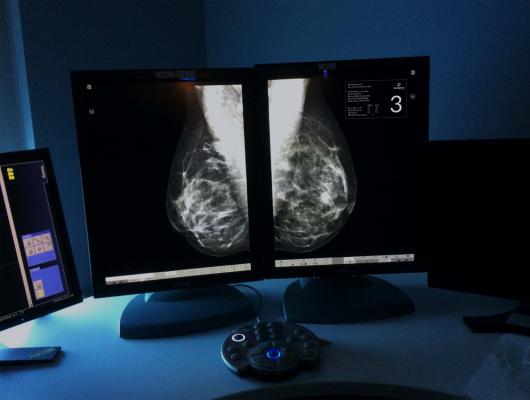
Ryan Tobin Photography for Densitas Inc.
August 17, 2015 — Patients with stage I, II or III breast cancer see marginal benefit on overall survival with irradiation of regional nodes, according to a new study from the European Organisation for Research and Treatment of Cancer (EORTC). Conducted at a median follow-up of 10.9 years, the study found that overall survival was 82.3 percent for regional irradiation versus 80.7 percent for no regional irradiation (HR=0.87 (95%CI: 0.76, 1.00), p=0.06).
The results, published in the New England Journal of Medicine, also showed that disease-free survival, distant-disease-free survival and breast cancer mortality were significantly improved. Side effects were very limited, although very long-term toxicity of radiation remains unknown.
The phase III EORTC 22922-10925 trial was conducted to evaluate what effect regional node irradiation — i.e., irradiation of the internal mammary and medial supraclavicular lymph nodes — would add to whole breast or chest wall irradiation following surgery in patients with stage I, II, and III breast cancer.
Prof. Philip Poortmans of the Radboud university medical center, Nijmegen, The Netherlands said: "We became interested in the role that elective regional radiation therapy might play following the publication of several studies that showed conflicting results of this treatment: one, an increased long-term mortality due to cardiac causes following outdated irradiation techniques; two, that loco-regional post-mastectomy radiation therapy had a favorable effect on disease-related endpoints; and three, that improved irradiation techniques led to lower cardiac exposure. Therefore, our study was highly needed to address the existing uncertainties concerning the role of lymph node irradiation. The results are very important as they show a clinically relevant decrease in distant-disease-free and disease-free survival, which points to the fact that the effect of radiation therapy should not only be measured by the influence on loco-regional control. Moreover, we expect that the currently modest benefit on overall survival will increase with longer follow-up, especially as we did not at all see any increase in other causes of death than cancer after regional irradiation."
From 1996 through 2004, this randomized trial coordinated by the EORTC Radiation Oncology and Breast Cancer Groups accrued 4,004 patients with either positive axillary lymph nodes or, in the case of tumor-free lymph nodes, centrally or medially located primary tumors. The investigators concluded that regional irradiation does benefit patients with early stage breast cancer, but they also point out that these data are not applicable to patients with laterally located node-negative cancers, the largest patient subgroup in industrialized countries. They plan to continue trial monitoring for up to 20 years median follow-up.
For more information: www.eortc.org

 October 09, 2026