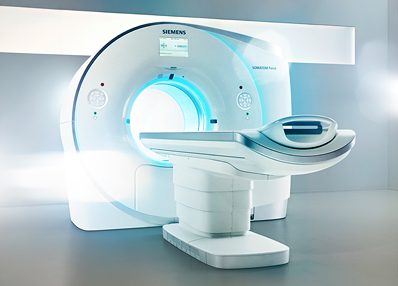
December 2, 2013 — Siemens Healthcare introduced Somatom Force, the company’s next-generation Dual Source computed tomography (CT) system, at the Radiological Society of North America Annual Meeting (RSNA 2013) in Chicago. The Somatom Force enables faster imaging, more precise diagnoses reduces doses for even more groups of patients. The system extends CT imaging capabilities and dose-reduction features to some of the most challenging patients, such as patients who are very young, suffering from renal insufficiency, seriously ill or obese.
Significantly Less Contrast
Patients suffering from renal insufficiency can benefit from imaging on the Somatom Force, which has the potential to allow radiologists to use significantly less contrast medium.
“Somatom Force negates many aspects of CT that until now have limited its application. For example, the administration of contrast medium that proves problematic for many patients can be greatly lowered,” said Walter Märzendorfer, CEO, CT and radiation oncology, Siemens Healthcare.
According to the national Centers for Disease Control and Prevention (CDC), more than 10 percent of adult Americans — over 20 million people — have renal insufficiency due to chronic kidney disease.[1] Contrast medium containing iodine can also place an additional burden on the kidneys of older patients — particularly those with chronic illnesses. Initial research examinations on Somatom Force show that it is possible to conduct chest studies with between 25 and 35 ml of contrast versus the commonly administered 90 to 110 ml. This reduction is made possible by the two Vectron X-ray tubes in Somatom Force, which enable routine examinations at tube voltages of 70 to 100 kilovolts. This low tube voltage increases the contrast-to-noise ratio and can reduce the amount of contrast medium accordingly.
Chest Imaging With No Breath-Hold
Somatom Force has the industry’s fastest acquisition rate of 737 mm per second, allowing an entire chest and abdomen study to be performed in just one second, which means that patients do not need to hold their breath. Because of the acquisition speed, even patients with high heart rates can be imaged without disruptive motion artifacts. In research use, Somatom Force has delivered diagnostic-quality images at a low dose for a patient with a 90 beats-per-minute heart rate with no use of beta blockers to slow the heart rate. Another advantage in chest imaging is the system’s enlarged 50 cm field of view in Turbo Flash Mode, which has an acquisition rate of almost 400 mm per second, allowing depiction of the entire chest in roughly one second.
Lung Cancer Detection at 50 Percent Lower Dose
The recent publication of results from the National Lung Screening Trial (NLST) lung cancer study, funded by the National Cancer Institute (NCI), has prompted a realignment of priorities in cancer prevention. The NLST study demonstrated that mortality rates can be reduced by 20 percent if early lung cancer detection is performed with low-dose CT versus conventional chest X-rays.[2] Somatom Force is particularly suitable for such early detection examinations because it is able to achieve previously unattained dose values in this type of setting — up to 50 percent lower radiation dose versus that of comparable CT systems, which is attributable to two special spectral filters known as Selective Photon Shields that optimize the X-ray spectrum to significantly improve the air/soft-tissue contrast. Early research examinations performed with Somatom Force show achievable dose values of 0.1 mSv for a lung scan.
The Somatom Force is pending U.S. Food and Drug Administration (FDA) 510(k) clearance and is not yet commercially available in the United States.
For more information: www.medical.siemens.com, www.rsna.org
References
[1] Centers for Disease Control and Prevention. National Chronic Kidney Disease Fact Sheet 2010.http://www.cdc.gov/diabetes/pubs/factsheets/kidney.htm
[2] National Lung Screening Trial Research Team, et al (2011). Reduced lung-cancer mortality with low-dose computed tomographic screening. N Engl J Med, 365:395-409.

 October 07, 2026