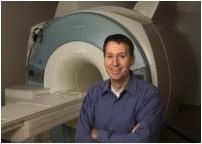
October 2, 2013 — A joint Brigham Young University-University of Utah research team is developing a new breast cancer screening technique that has the potential to reduce false positives and, possibly, minimize the need for invasive biopsies.
Led by BYU electrical engineer Neal Bangerter and University of Utah collaborators Rock Hadley and Joshua Kaggie, the group has created a magnetic resonance imaging (MRI) device that could improve both the process and accuracy of breast cancer screening by scanning for sodium levels in the breast.
The device is producing as much as five times more accurate images than previous efforts with an emerging methodology called sodium MRI. Sodium MRI has the potential to improve assessment of breast lesions because sodium concentrations are thought to increase in malignant tumors. Bangerter and his team believe that the addition of sodium MRI to a breast cancer screening exam could provide important additional diagnostic information that will cut down on false positives.
The team has developed a new device used for sodium imaging that is picking up a level of detail and structure not previously achieved.
"This development by Dr. Bangerter and his group represents a major advance in the field of multinuclear MRI of the breast," said Stanford Professor of Radiology Bruce Daniel. "He and his group have invented a way to dramatically boost the sodium signal from the breast, enabling much better, higher resolution sodium MR images to be obtained. This should open the door to new avenues of research into breast cancer."
So far, the technique returns high-quality images in 20 minutes, improving the odds that sodium MRI breast scans could be implemented clinically.
The MRI team's goal is to produce a device capable of obtaining both excellent sodium and good proton images without requiring the patient being screened to be repositioned for multiple scans.
"This method is giving us new physiological information we can't see from other types of images," Bangerter said. "We believe this can aid in early breast cancer detection and characterization while also improving cancer treatment and monitoring."
For more information: www.eurekalert.org
 October 09, 2026