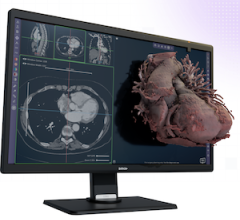
The image above shows a CT angiogram of bilateral middle cerebral artery aneurysms. Photo courtesy of Dartmouth Hitchcock Medical Center.
September 3, 2009 - Sixty-four-detector CT angiography is an accurate imaging method for the detection of aneurysms, and may be used as the initial imaging technique in the diagnostic work-up of patients suspected of having intracranial aneurysms, reported a study published in the September 2009 issue of Radiology.
In the study, Evaluation of 64-Section CT Angiography for Detection and Treatment Planning of Intracranial Aneurysms by Using DSA and Surgical Findings, researchers set out to investigate the diagnostic performance of 64-section CT angiography in the detection of intracranial aneurysms. All patients underwent both 64-detector CT angiography and digital subtraction angiography (DSA) for the detection of intracranial aneurysms. Two independent blinded readers reviewed the CT angiograms. Sensitivity, specificity, and positive and negative predictive values for aneurysm detection with CT angiography were calculated by using DSA and surgical findings as the reference standard.
Doctors identified 107 aneurysms in 96 patients, and DSA helped detect 106. On a per-aneurysm basis, the sensitivity, specificity, and positive and negative predictive values for CT angiography were 99 percent, 100 percent, and 100 percent and 92.3 percent, respectively. For aneurysms smaller than 3-mm, sensitivity was 93.7 percent for reader 1 and 96.8 percent for reader 2. However, the sensitivity and specificity were both 100 percent for aneurysms larger than 3-mm. Therapeutic decisions could be made on the basis of information provided by CT angiography.
Reference: Li, MD, Qi, et al. Evaluation of 64-Section CT Angiography for Detection and Treatment Planning of Intracranial Aneurysms by Using DSA and Surgical Findings. Radiology: Volume 252: Number 3. September 2009.
For more information: www.rsna.org

 August 21, 2026