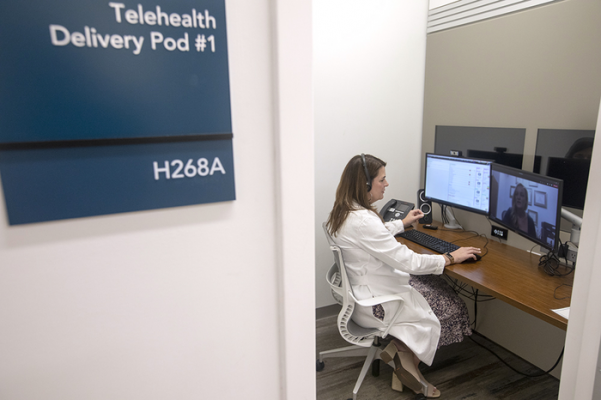
Dr. Dee Ford, program director of the National Telehealth Center of Excellence at the Medical University of South Carolina, demonstrates a telehealth visit. Photo courtesy of Medical University of South Carolina, Sarah Pack
August 24, 2021 — Telehealth came into its own during the COVID-19 pandemic, providing patients access to care in the face of social distancing restrictions. But long before, it had been offering medically underserved patients high-quality health care.
A new article in Telemedicine Reports outlines the Telehealth Service Implementation Model (TSIM), which was developed at the Medical University of South Carolina (MUSC). TSIM emerged out of MUSC’s own experience establishing a successful and comprehensive telehealth program. MUSC now offers more than 80 different telehealth services at nearly 275 clinical sites across South Carolina.
TSIM addresses the challenges associated with developing, implementing and sustaining a successful telehealth program. It provides a detailed roadmap for institutions that began to offer telehealth services during the pandemic and wish to find a sustainable way to continue to do so as well as for organizations that have not yet embarked on a telehealth journey.
Telehealth challenges the traditional roles, procedures and models of health care, according to Dee Ford, M.D., senior author of the article and program director of MUSC’s National Telehealth Center of Excellence, one of two federally recognized programs.
“One of the intrinsic challenges with telehealth is change,” explained Ford. “There is change for providers and change for patients when transitioning to telehealth. Ensuring, achieving and maintaining provider and patient engagement is absolutely critical in building a successful telehealth program.”
Additional barriers in developing and sustaining telehealth programs include technical, financial, regulatory and administrative burdens, explained Shawn Valenta, lead author of the article and vice president of healthcare cloud services at Wellpath. Valenta, who previously served as the administrator for the MUSC Health Center for Telehealth, was one of the creators of TSIM.
“Telehealth brings the expertise of health care providers together to develop clinical services provided via technology,” explained Valenta. “Navigating legal and regulatory barriers, as well as issues related to data, finance and technology, all create development and implementation challenges.”
TSIM helps health care institutions to pilot any turbulence they may encounter while incorporating telehealth services.
“TSIM organizes all of the steps involved in developing a telehealth program,” said Ford. “It is strategy driven and provides workflows for the clinical, administrative, regulatory and technology components of telehealth. TSIM doesn’t stop there, though; it continues into telehealth application and quality assessment.”
The value of telehealth became apparent during the COVID-19 pandemic, when many health care institutions invested in technology to establish their own telehealth programs so that they could continue to serve patients.
“There is a lot of investment in digital health technology, which is great, but an investment in how to use these technologies effectively – which is essentially TSIM – will endure even when technologies change,” said Valenta.
Ford and Valenta are among the editors of a TSIM-specific book being published by TSO, which can be preordered on its website. Other editors include James McElligott, M.D., Kathryn King, M.D., and Emily Warr, all of the Center for Telehealth, and Jillian Harvey, Ph.D., of the Department of Healthcare Leadership & Management in the College of Health Professions.
Ford and Valenta also edited an earlier book, titled Telemedicine: Overview and Application in Pulmonary, Critical Care, and Sleep Medicine, which addresses the implementation and management of telehealth in these fields, is available for purchase on the Springer website.
For more information: web.musc.edu/innovation/frd
 October 19, 2026