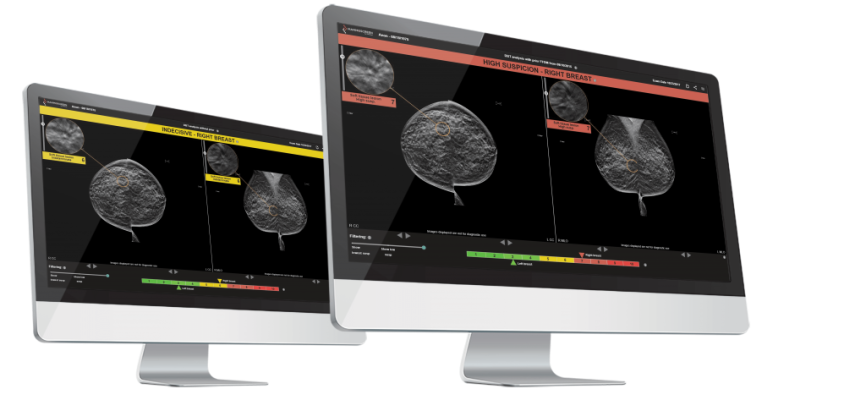
May 18, 2022 — Therapixel, a company leading the use of AI-based software for women’s health, announces it has released a new version of MammoScreen – 2D and 3D – capable of using prior mammograms into its analysis. By comparing a mammogram to the previous examinations, MammoScreen further improves its performances.
From a database of more than 8 million images, Therapixel has trained a deep learning algorithm able to use prior images. Mimicking what radiologists do, the algorithm uses prior images to detect changes in the present mammogram. Essentially, this feature makes the system more confident if a lesion is suspicious or not.
MammoScreen automatically detects and characterizes suspicious soft tissue lesions and calcifications in mammography and tomosynthesis images while assessing their level of suspicion. The results are summarized in the MammoScreen Score that grades each lesion on a scale of 1-10, with 1 being the least likely to reveal a malignancy and 10 being the most likely. From prior images, the system evaluates if a lesion is evolving over time: a stable lesion might result in a less suspicious score, conversely a growing lesion might have a more pejorative score.
“Incorporating priors in the MammoScreen analysis is a major milestone for breast cancer AI,” said Pierre Fillard, Ph.D., Founder and Chief Scientific Officer of Therapixel. “Our product is now able to consider temporal changes and be more confident in its assessment. With this first version, MammoScreen is now able to detect 30% of the cancer cases without creating any false positive.”
“We are very proud to be the first company to release such feature.” said Matthieu Leclerc-Chalvet, Therapixel CEO. “Using most of the pertinent data available is important to have radiologists trusting the software even more. The software will mark more meaningful lesions that will help radiologists to be more comfortable with the lesion marks. In addition, for the least suspicious cases, knowing that the software has also analyzed the prior. Radiologists should be reassured that the software hasn’t missed anything, and that they can go faster reading these cases. In addition, this allows radiologists to focus on the cases that need the most attention. We expect this feature to accelerate the adoption of AI and will definitively contribute to differentiate AI-based software from traditional Computer Assisted Detection (CAD) systems.”
Breast cancer is the second cause of cancer death worldwide. In the United-States, 1 in 8 women will develop breast cancer during their lifetime. Early detection is the key to successful treatment.
For more information: www.therapixel.com
 October 09, 2026