May 23, 2013 — Syntermed Inc. has been awarded 510(k) clearance for Emory Cardiac Toolbox version 4.0.
"One of the many things that makes Emory Toolbox 4.0 different is SmartReport, the first-ever, cloud-based nuclear cardiology reporting tool using decision support,” said Michael Lee, CEO, Syntermed Inc. The decision support system that powers SmartReport is called Syntermed IDS and will allow diagnosticians to perform faster, more accurate nuclear cardiology reports from single photon emission computed tomography (SPECT) and positron emission tomography (PET) heart scans.
The new Emory Toolbox 4.0 was totally rebuilt on a progressive .NET framework to maximize the computer and network technologies, but it still has the same familiar user-guide. Designed to increase lab workflow and efficiency, Toolbox 4.0 has a more intuitive user interface that supports a dynamic windows manager and a new 3-D display, and it offers simplified packaging whereby many of the existing tools are now a standard part of Toolbox 4.0.
“Syntermed Live, now in its sixth year of operation, gives physicians convenient 24/7-365 days a year remote access to studies and reports,” said Lee. “With the advent of Emory Toolbox 4.0 and our new SmartReport, powered by Syntermed IDS, reports are not only cloud-accessible but can now be fully integrated with electronic medical records (EMR) at the hospital enterprise level.”
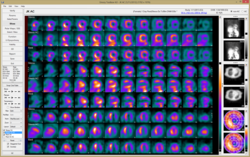
The Emory Toolbox 4.0 is an Internet — Wi-Fi-based system and acquires the data from the electrocardiography (ECG)-gated myocardial perfusion SPECT studies, automatically reconstructing the data, then analyzing and converting it to quantitative parameters or factors of abnormality. This data is then submitted to an imaging decision support system that is continuously updated with the to reach an impression of the patient's heart status. The physician then sees the justification for the diagnosis and can make changes to the report. The entire process is designed to be faster, more efficient and user-friendly while providing a comprehensive report that is more easily accessible given today’s technology.
For more information: www.syntermed.com

 October 16, 2026