Courtesy of MarketsandMarkets Research
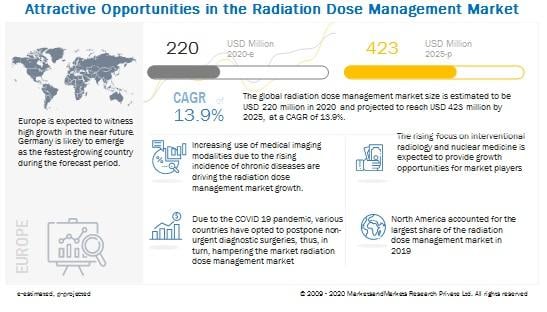
August 3, 2020 — According to the new market research report "Radiation Dose Management Market by Products & Services (Standalone Solutions, Integrated Solutions, Services), Modality (Computed Tomography, Nuclear Medicine), Application (Oncology, Cardiology, Orthopedic), End User (Hospitals) - Global Forecast to 2025", published by MarketsandMarkets, the radiation dose management market is projected to reach USD 422.65 million by 2025 from USD 220.22 million in 2020, at a CAGR of 13.9%.
The growth in this market is attributed to the increasing use of medical imaging modalities due to the rising incidence of chronic diseases, increasing concerns over radiation dose exposure, growth in the installed base of radiology equipment, and growing awareness on radiation dose management.
Radiation dose management solutions accounted for the larger share of the Radiation Dose Management Market in 2019
On the basis of product & service, the market is segmented into radiation dose management solutions and radiation dose management services. In 2019, the radiation dose management solutions segment accounted for the larger share of the market. The large share of this segment can be attributed to the increasing adoption of radiation dose management solutions by healthcare providers owing to the growing regulations regarding ionizing radiation across the globe.
By application, the oncology segment accounted for the largest market share in 2019
Based on application, the market is segmented into oncology, cardiology, orthopaedic application and other application. The oncology segment accounted for the largest market share in 2019. The rising prevalence of cancer, the need for advanced diagnostic technologies has increased. This has resulted in the rising adoption of imaging techniques for cancer detection and treatment planning, thus driving the demand for radiation dose management software as well.
Hospitals are the largest end users of the Radiation Dose Management Market
Based on end users, the market is segmented into hospitals, ambulatory care settings, and other end users. The hospitals segment accounted for the largest market share in 2019. The rising patient population, growing awareness about the benefits of early disease diagnosis, technological advancements in imaging modalities, and the increasing awareness of the harmful effects of radiation exposure are some of the major factors responsible for the high demand for radiation dose management solutions in hospitals.
North America dominates the global Radiation Dose Management Market
The market is segmented into four major regional segments, namely, North America, Europe, Asia Pacific, and the Rest of the World. In 2018, North America accounted for the largest share of the market. The large share of North America can be attributed to factors such as the stringent legislative and accreditation requirements regarding the reporting and optimization of radiation doses, high adoption of HCIT technologies, and the presence of stringent regulatory requirements regarding patient safety.
The major players in the Radiation Dose Management Market are Bayer AG (Germany), GE Healthcare (US), PACSHealth, LLC (US), and Sectra Medical Systems (Sweden). Other prominent players in this market include Philips Healthcare (Netherlands), Fujifilm Holdings Corporation (Japan), Novarad Corporation (US), Siemens Healthineers (Germany), Agfa HealthCare (Belgium), Canon (Japan), and Qaelum N.V. (Belgium).
For more information: www.marketsandmarkets.com

 October 08, 2026