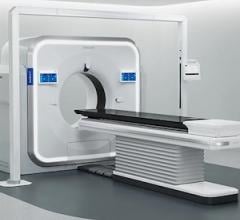
January 25, 2011 — Royal Philips Electronics has announced CE marking for the industry’s first commercially available whole-body positron emission tomography/magnetic resonance (PET/MR) imaging system, the Ingenuity TF PET/MR. The system is pending 510(k) and not available for sale in the U.S.
The new system, being launched as the first new Philips modality in 10 years, integrates the molecular imaging capabilities of PET with the superior soft tissue contrast of MR to image disease cells as they proliferate in soft tissue. Since the Ingenuity TF PET and MR scanners are placed only three meters apart and the patient table rotates to allow the patient to be scanned by each modality, the system can also acquire separate PET and MR images.
Clinicians anticipate using the Ingenuity TF PET/MR to screen patients at high-risk for heart disease to ultimately treat diseased cells prior to the formation of dangerous coronary plaques. The system may also be used to scan patients to detect tumor formation/recurrence. Since the Ingenuity TF PET/MR provides the best of Astonish TF PET and 3T MR, it is also possible to track whether a drug is reaching a tumor or plaque and monitor efficacy on a potential cellular level. In addition to greater visualization of disease process, the system can also produce up to 70% less ionizing radiation than PET/CT. 1, 2
The University Hospital of Geneva houses Europe’s first combined whole-body PET/MR system. Professor Zahi Fayad, professor of radiology and medicine (cardiology), and director, Translational and Molecular Imaging Institute, Mount Sinai School of Medicine in New York, N.Y., and Prof. Joerg Steinbach, Director, Institute of Radiopharmacy, Helmholtz-Zentrum Dresden-Rossendorf (HZDR), Dresden, Germany, also installed the Ingenuity TF PET/MR. In 2011, additional installations are expected worldwide.
For more information: www.philips.com/newscenter
1 Brix G, Lechel U, Glatting G, Ziegler SI, Munzing W, Muller SP, et al. Radiation exposure of patients undergoing whole-body dual-modality 18F-FDG PET/CT examinations. J Nucl Med 2005;46:608-13.
2 Brix G, Beyer T. PET/CT: dose-escalated image fusion?, Nuklearmedizin 2005;44:S51-57.

 October 08, 2026