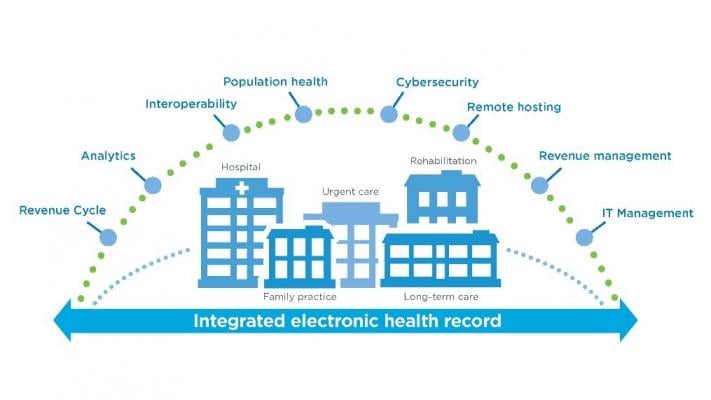
July 30, 2020 — Nuance Communications, Inc. announced that it has expanded its long-standing artificial intelligence (AI) collaboration with Cerner Corporation to include the integration of Nuance's virtual assistant technology into the Cerner Millennium electronic health record (EHR). Building upon the existing integration between Nuance's Dragon Medical platform and Cerner Millennium, joint clients can utilize Nuance's advanced natural language virtual assistant technology to navigate the EHR using just their voice, giving clinicians more time to spend with their patients and less time with their computer.
The expanded Nuance-Cerner relationship is driven by the healthcare industry's need to mitigate what the World Medical Association is calling a "pandemic of physician burnout" with 51 percent of physicians reporting frequent or constant feelings of burnout. This is caused by a staggering administrative workload of electronic paperwork to document patient care and to meet requirements for insurance coverage, financial reimbursement, and medicolegal liability protection. Research shows that more than 80 percent of physicians believe virtual assistants in health care can reduce the burden on care teams and improve the patient experience. Nuance's virtual assistant technology helps physicians rapidly accomplish tasks and communicate more naturally, while allowing them to use specialized medical terminology across a range of devices and applications with high accuracy.
"Health systems and their care teams are facing unprecedented challenges as they strive to deliver great patient care while dealing with extreme financial pressures and a worldwide pandemic. At Cerner, we are committed to continuing to deliver leading-edge AI-powered solutions, leveraging our open platform approach, to reduce the administrative burden on care teams so they can focus on the patient," said Tanuj Gupta, vice president and physician executive, Cerner Intelligence, Cerner. "With digital transformation happening at a breakneck speed, we are excited to expand our leading AI-enabled technology offerings with Nuance to help us fulfill this mission."
Nuance's deeply embedded virtual assistant technology delivers sophisticated conversational dialogues and skills that automate high-value clinical tasks inside Cerner Millennium, such as chart search, navigation, intelligent computerized physician order entry (CPOE), and scheduling. Nuance technology's high accuracy rates, rich set of voice-activated skills and ability to understand the user's intent in context provides higher levels of workflow automation and more efficient and complete documentation of patient care. Additionally, Nuance's pre-built, HIPAA-compliant natural language understanding models and cloud platform will support Cerner to deploy the solution quickly and easily to joint clients.
"Together with Cerner, we're bringing the next level of conversational AI directly to our joint clients with the goals of improving patient experiences, combating clinician burnout, and reducing costs," said Joe Petro, CTO, Nuance. "Building on our Dragon Medical platform, already used by over 550,000 physicians in the U.S. alone, our new virtual assistant technology will help deliver solutions that automate time-consuming tasks, eliminate inefficiencies, and bring clinical intelligence and better decision-support to clinicians at the point of care."
Select joint Cerner and Nuance clients can expect to start deploying this integrated virtual assistant technology later this year.
For more information: www.nuance.com

 October 07, 2026