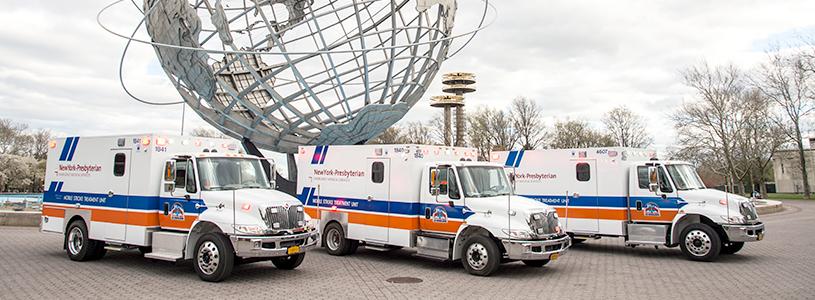
Image courtesy of NewYork-Presbyterian Hospital
June 11, 2018 — NewYork-Presbyterian, in collaboration with Weill Cornell Medicine, Columbia University Irving Medical Center and the Fire Department of New York (FDNY), is expanding its fleet of Mobile Stroke Treatment Units (MSTU) to Queens and Brooklyn. Thanks to a generous donation by the W.P. Carey Foundation, this makes NewYork-Presbyterian the first health system in the country to operate three of these advanced units.
The MSTU is an emergency vehicle equipped to provide immediate, specialized care to patients who may be experiencing a stroke. The unit uses advanced telemedicine technology, allowing neurologists from NewYork-Presbyterian’s hospital locations to be consulted remotely and at a moment’s notice.
“We are extremely grateful to our donors for their support in helping us provide life-saving stroke treatment with significantly reduced treatment times to the communities of Queens and Brooklyn,” said Steven J. Corwin, M.D., president and CEO of NewYork-Presbyterian. “NewYork-Presbyterian is proud to be a leader in advanced stroke care by becoming the first to operate three Mobile Stroke Treatment Units.”
Every year, approximately 795,000 people in the United States suffer from a blockage in an artery of the brain, depriving it of blood flow and oxygen, which, over the course of minutes, can lead to disability or death. Stroke is one of the most widespread and debilitating conditions and a leading cause of serious long-term disability in the United States.
On April 30, the New York City 911 System via the FDNY began deploying a unit in the community surrounding NewYork-Presbyterian Queens, an ACS Level 1 Trauma Center and certified Primary Stroke Center by the Joint Commission and by the New York State Department of Health (NYSDOH). Beginning May 28, it deployed a unit in the community surrounding NewYork-Presbyterian Brooklyn Methodist Hospital, an ACS Level 2 Trauma Center and certified NYSDOH Stroke Center.
NewYork-Presbyterian launched the city’s first MSTU – and the first of its kind on the East Coast – in October 2016.
“Response time is a critical factor in stroke recovery and the Mobile Stroke Treatment Units now have the capacity to help even more patients,” said Matthew E. Fink, M.D., who oversees the MSTU program and is neurologist-in-chief at NewYork-Presbyterian/Weill Cornell Medical Center, and chairman of the Department of Neurology and the Louis and Gertrude Feil Professor in Clinical Neurology at Weill Cornell Medicine. “We are bringing the emergency room directly to a patient suffering a stroke. This is a game changer in advanced stroke care.”
“The FDNY is proud to once again partner with NewYork-Presbyterian to integrate two new Mobile Stroke Treatment Units into the 911 system for rapid treatment of patients suffering a stroke,” said Fire Commissioner Daniel A. Nigro. “Our FDNY paramedics, EMTs and firefighters will work closely with these units to continue critical pre-hospital care, potentially saving many more lives.”
Each MSTU is staffed by a highly specialized team of two NYP paramedics, a computed tomography (CT) technologist and a registered nurse. A neurologist is consulted remotely via videoconferencing, an advancement that allows the physician to speak with and view the patient and provide an assessment and recommendations for care. It is designed to significantly reduce the time from the onset of symptoms to the delivery of care, a crucial factor in improving stroke outcomes.
The unit also contains equipment and medications specific to diagnosing and treating strokes, including a medication called tPA, which dissolves the clot and improves blood flow to the part of the brain being deprived of blood in the event of an ischemic stroke. The MSTU also has a portable CT scanner that can image the patient’s brain instantly to detect if the patient is having a stroke. The CT scan is then wirelessly transmitted to a NewYork-Presbyterian neuroradiologist to be promptly evaluated.
During its first year of service, from October 2016 through October 2017, the Manhattan MSTU was deployed 454 times, transported 88 patients and administered tPA 34 times. Since the launch, the MSTU has been able to treat stroke victims approximately 40 minutes faster than a standard ambulance transport.
Once a patient is admitted to the hospital, the MSTU team works to gather pertinent data, including the patient’s outcome after 90 days, the percentage of patients treated by the MSTU who made a full recovery compared with those delivered by standard Emergency Medical Services transport, as well as overall cost of care. A larger analysis is currently in progress that will share information from similar units across the United States in order to understand and provide best treatment practices for emergency stroke care.
Watch a video about the NYP MSTU
For more information: www.nyp.org/mstu
Related Mobile Stroke Content
VIDEO: Creating and Operating a Mobile Stroke Unit
Northwestern Medicine Mobile Stroke Unit Delivers Life-Saving Care 30 Minutes Sooner

 October 07, 2026