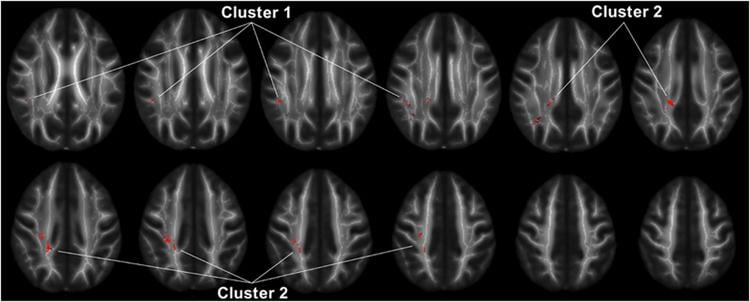
Regions of the white matter skeleton in which connectivity in IED subjects was significantly lower than healthy controls. Image courtesy of Lee, et al, Neuropsychopharmacology
July 19, 2016 — People with intermittent explosive disorder (IED), or impulsive aggression, have a weakened connection between regions of the brain associated with sensory input, language processing and social interaction.
In a new study published in the journal Neuropsychopharmacology, neuroscientists from the University of Chicago show that white matter in a region of the brain called the superior longitudinal fasciculus (SLF) has less integrity and density in people with IED than in healthy individuals and those with other psychiatric disorders. The SLF connects the brain’s frontal lobe — responsible for decision-making, emotion and understanding consequences of actions — with the parietal lobe, which processes language and sensory input.
“It’s like an information superhighway connecting the frontal cortex to the parietal lobes,” said Royce Lee, M.D., associate professor of psychiatry and behavioral neuroscience at the University of Chicago and lead author of the study. “We think that points to social cognition as an important area to think about for people with anger problems.”
Lee and his colleagues — including senior author Emil Coccaro, M.D., Ellen C. Manning Professor and Chair of Psychiatry and Behavioral Neuroscience at UChicago — used diffusion tensor imaging, a form of magnetic resonance imaging (MRI) that measures the volume and density of white matter connective tissue in the brain. Connectivity is a critical issue because the brains of people with psychiatric disorders usually show very few physical differences from healthy individuals.
“It’s not so much how the brain is structured, but the way these regions are connected to each other,” Lee said. “That might be where we're going to see a lot of the problems in psychiatric disorders, so white matter is a natural place to start since that's the brain's natural wiring from one region to another.”
People with anger issues tend to misunderstand the intentions of other people in social situations. They think others are being hostile when they are not and make the wrong conclusions about their intentions. They also don’t take in all the data from a social interaction, such as body language or certain words, and notice only those things that reinforce their belief that the other person is challenging them.
Decreased connectivity between regions of the brain that process a social situation could lead to the impaired judgment that escalates to an explosive outburst of anger. The discovery of connectivity deficits in a specific region of the brain like the SLF provides an important starting point for more research on people with IED, as well as those with borderline personality disorder, who share similar social and emotional problems and appear to have the same abnormality in the SLF.
“This is another example of tangible deficits in the brains of those with IED that indicate that impulsive aggressive behavior is not simply ‘bad behavior’ but behavior with a real biological basis that can be studied and treated,” Coccaro said.
The study, “White Matter Integrity Reductions in Intermittent Explosive Disorder,” was supported by the National Institute of Mental Health. Additional authors include Jennifer Fanning and Sarah Keedy from the University of Chicago, and Konstantinos Arfanakis and Arnold Evia from the Illinois Institute of Technology.
For more information: www.nature.com/npp

 October 07, 2026