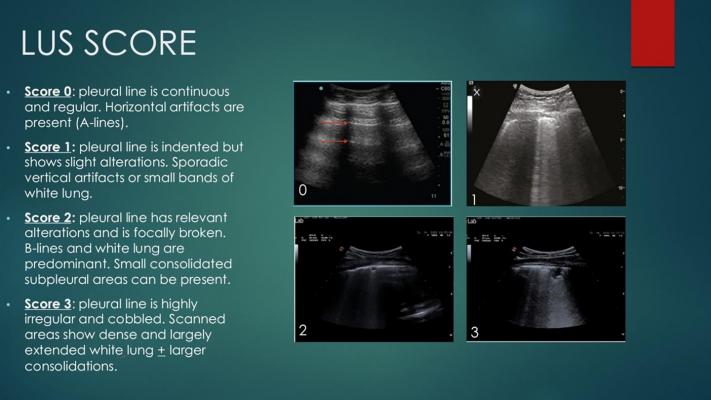
Using 14 points in the lungs, researchers looked for abnormalities and assigned each spot a score out of 3 based on its severity. Adding up all the points, they found the total lung ultrasound score was higher for those who had a worsening outcome of COVID-19. Image courtesy of Umberto Sabatini
December 11, 2020 — For some, COVID-19 can result in severe pneumonia or even death, while others remain purely asymptomatic. A diagnostic tool could help physicians predict if a patient with COVID-19 will worsen.
Researchers at the Policlinico San Matteo, in Pavia, Italy, have developed a method using ultrasound imaging to score a patient's lung health, which is indicative of their outcome. The ability to predict when a patient might worsen can help physicians be better prepared for caring for patients.
Umberto Sabatini's presentation, "Is lung ultrasound a predictor of worsening in Covid-19 patients?" will be a part of the 179th Meeting of the Acoustical Society of America.
The researchers tested the tool on 52 patients who had been admitted to San Matteo Hospital between March 15 and April 29. They administered lung ultrasounds to the patients on arrival and before discharge to get a peek into the state of their lungs. Using 14 points in the lungs, the researchers looked for abnormalities, such as pleural irregularities, and assigned each spot a score out of 3 based on its severity.
Adding up all the points, the researchers found the total lung ultrasound score was higher for those who had a worsening outcome of COVID-19, such as needing supplementary oxygen, admission to intensive care, or death. Patients with at least three spots scoring 3 or with high overall scores were more than six times more likely to have a worsening outcome than other patients.
From their results, the researchers proposed a graph called a nomogram that can help physicians compute the probability a patient will worsen based on their lung ultrasound score.
The diagnostic will help physicians rapidly evaluate and predict how a patient will worsen due to COVID-19. The test is also quick to perform. A scan of each spot takes 10 seconds, making the whole exam last only 15 to 20 minutes.
For more information: acousticalsociety.

 October 08, 2026