February 27, 2024 — Hologic, Inc. continues to deliver on its commitment to advancing women’s health by unveiling new research in artificial intelligence (AI) and offering innovative educational opportunities at the annual European Congress of Radiology (ECR) in Vienna, Austria from February 28 to March 2.
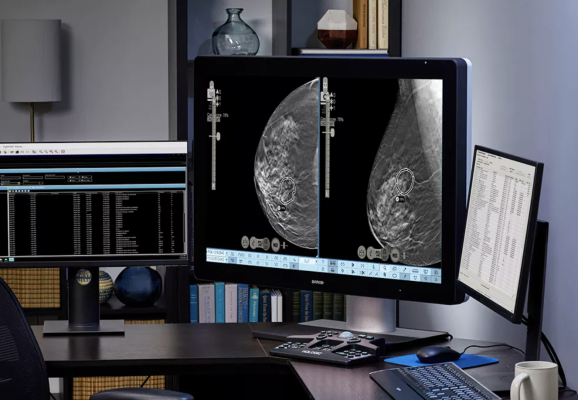
The pioneer behind 3D mammography, Hologic will present new data that showcase how next-generation deep-learning solutions can assist with breast cancer detection and improve workflow for radiologists. Presented by esteemed breast imaging specialist and study author Dr. Sarah M. Friedewald, Associate Professor of Radiology and Chief of Breast Imaging at Northwestern Memorial Hospital, the research shows that Hologic’s Genius AI® Detection solution has an exceptional ability to correctly match pairs of Regions of Interest (ROIs) in different views.1
“These data reveal how AI can help us correlate ROIs in a way that we have never seen before, which underscores that deep-learning technology can supplement our workflow as radiologists and help us provide better patient care,” said Dr. Friedewald. “Beyond its impact on our daily practices, these data emphasize the transformative potential AI has to drive improvements across the breast health spectrum. I’m looking forward to sharing this information with my colleagues from around the globe at ECR.”
In addition, Dr. Friedewald will also present research highlighting how the Genius AI Detection algorithm can help radiologists identify potential cancers on mammograms previously interpreted as normal.2 In a third study, research will be presented that demonstrates Hologic’s deep learning-based AI algorithm can help significantly enhance performance, surpassing traditional machine learning Computer-Aided Detection (CAD) algorithms in specificity and overall effectiveness.3
“Research and education are central tenets of Hologic’s innovation, to support radiologists in achieving better patient outcomes,” said Tanja Brycker, Vice President, Strategic Development, Breast & Skeletal Health and Gynecological Surgical Solutions at Hologic. “We’re excited to present groundbreaking research at ECR and to continue our collaboration with Bayer on contrast-enhanced mammography. By offering our customers the opportunity to engage with world-renowned experts and explore our latest technology, we are ensuring they feel confident in their patient care procedures and decisions.”
Hologic and Bayer will co-sponsor a contrast-enhanced mammography (CEM) symposium, facilitated by globally recognized breast imaging radiologists Dr. Jacopo Nori, Chief of Breast Imaging at Careggi University Hospital in Florence, Italy, and Dr. Marc Lobbes, Chairperson of the Board, Department of Medical Imaging at Zuyderland Medical Center in Sittard-Geleen, the Netherlands.
The symposium, which will take place on Thursday, February 29 at 11 a.m. CET, is designed to provide radiologists with an understanding of how CEM can be effectively implemented into their daily practice.
Hologic’s Genius AI Detection technology is a cutting-edge solution now commercially available in the U.S., with plans for rollout in Europe, Canada and Asia by the end of 2024.
For more information: www.hologic.com
References:
|
1 |
Correlating breast lesions in tomosynthesis CC and MLO views using artificial intelligence (AI). Authors: Sarah Friedewald (Northwestern), Chirag Phargi (Solis). Accepted as podium presentation. |
|
|
2 |
Evaluating performance of an artificial intelligence (AI) detection system on prior screening tomosynthesis studies of breast cancer patients. Authors: Sarah Friedewald (Northwestern), Chirag Phargi (Solis). Accepted as podium presentation. |
|
|
3 |
Performance of a traditional machine learning computer-aided detection (CADe) algorithm versus a deep learning artificial intelligence (AI) algorithm on digital breast tomosynthesis (DBT) studies. Authors: Manisha Bahl (MGH), Constance Lehman (MGH). Accepted as electronic poster. |
 October 19, 2026