GE Healthcare Revolutionizes the MR Patient Scanning Experience with Silent Scan
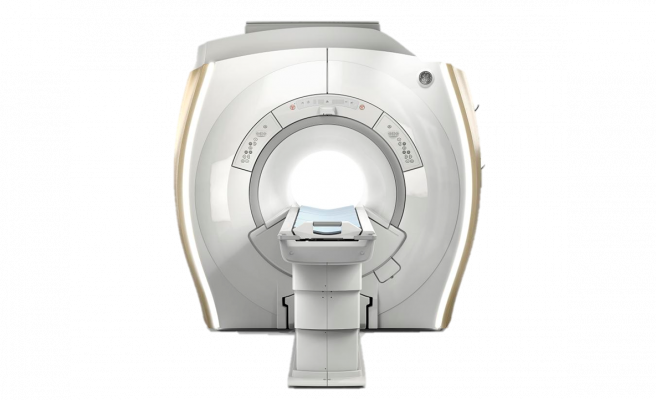
November 30, 2012 — At RSNA 2012, GE Healthcare introduced the 510(k) pending Silent Scan, a revolutionary technology designed to address one of the most significant impediments to patient comfort — excessive acoustic noise generated during an magnetic resonance imaging (MR) scan. Conventional MR scanners can generate noise in excess of 110 dBA (decibels) levels, roughly equivalent to rock concerts, and require ear protection. GE’s exclusive Silent Scan technology is designed to reduce MR scanner noise to near ambient (background) sound levels and thus can improve a patient’s MR exam experience.
“Silent Scan is a huge breakthrough for the MR industry and for patients around the world,” says Richard Hausmann, president and CEO, GE Healthcare MR. “Excessive acoustic noise is a major cause of patient discomfort during MR scans and GE is addressing that with Silent Scan, a new MR advanced application and a major innovation in the healthcare industry. GE is very serious about humanizing MR and making its MR systems patient-friendly, safe, and without compromise.”
Historically, acoustic noise mitigation techniques have focused on insulating components and muffling sound as opposed to treating the noise at the source. With Silent Scan, acoustic noise is essentially eliminated by employing a new advanced 3-D acquisition and reconstruction technique called Silenz, in combination with GE Healthcare’s proprietary design of the high-fidelity MR gradient and RF system electronics. Silent Scan is designed to eliminate the noise at its source; with Silent Scan, patients will experience a more relaxing scanning environment.
Silent Scan is one way in which GE MR is humanizing MR and putting patients first. GE’s MR systems deliver superb image quality and an optimized patient experience, balancing caring design with insightful technology. Another example of this on display at RSNA is the Optima MR430s 1.5T extremity scanner, which allows patients to undergo an MR exam while sitting in a chair, with Image Quality equivalent to a traditional whole body MR system.
Silent Scan is 510(k) pending at U.S. FDA and not available for sale.
For more information: www.gehealthcare.com

 October 07, 2026