News | Breast Imaging | March 18, 2021

According to AJR, contrast-enhanced mammography showed concordance with MRI in women with newly diagnosed breast cancer and breast augmentation

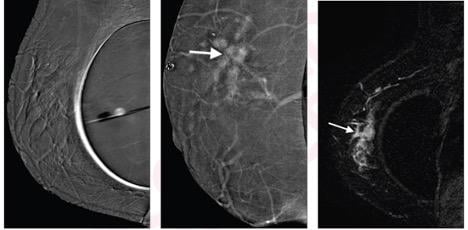
Left to right: Subtraction right mediolateral oblique (MLO) CEM was non-diagnostic because of artifact, potentially due to motion misregistration from extended exposure time; subtraction right MLO implant displaced CEM image shows 5.8 cm enhancing mass (arrow); contrast-enhanced MRI sagittal subtraction image shows concordant mass (arrow).

Left to right: Subtraction right mediolateral oblique (MLO) CEM was non-diagnostic because of artifact, potentially due to motion misregistration from extended exposure time; subtraction right MLO implant displaced CEM image shows 5.8 cm enhancing mass (arrow); contrast-enhanced MRI sagittal subtraction image shows concordant mass (arrow).


March 18, 2021 — According to ARRS’ American Journal of Roentgenology (AJR), contrast-enhanced mammography (CEM) showed concordance with magnetic resonance imaging (MRI) in women with newly diagnosed breast cancer and breast augmentation.

Noting that CEM has not been investigated in women with breast augmentation, Molly Carnahan and her Mayo Clinic team in Phoenix, AZ, concluded, “the findings suggest a possible role of CEM for staging in women with breast augmentation and contraindication or limited access to MRI.”

From an institutional database of 2,215 women who underwent CEM between January 2015 and March 2020, the researchers identified breast implants in 67 women: 42 without corresponding MRI, 3 without breast cancer, 1 with axillary disease only, and 6 with neoadjuvant chemotherapy before CEM or MRI — leaving a final sample of 17 women (mean age 52 years; 6 with non-dense breasts, 11 with dense breasts).

The index cancer histology was invasive ductal carcinoma (IDC) in 15 (88%) women, invasive lobular carcinoma (ILC) in 1 (6%), and ductal carcinoma in situ in 1 (6%). Median index cancer size was 2 cm, and 2 (12%) index cancers were mammographically occult. Ultimately, CEM and MRI were concordant for the index cancer in all 17 women.


Six additional lesions were demonstrated by CEM and confirmed by MRI in 6 (35%) women: 3 multifocal, 1 multicentric, 2 contralateral. Two of these lesions revealed malignant histopathology: 1 IDC, 1 ILC.

“MRI did not identify any additional cancers not identified on CEM,” the authors of this AJR article added.

For more information: www.arrs.org

Related Content

News | Breast Imaging

Aug. 13, 2026 – Perimeter Medical Imaging AI recently announced that Intermountain Health, the largest nonprofit health ...

Time August 14, 2026
arrow
News | Breast Imaging

Aug. 3, 2026 — QT Imaging Holdings, is advancing the direct U.S. commercial strategy for its Breast Acoustic CT Scanner ...

Time August 04, 2026
arrow
News | Breast Imaging

Aug. 3, 2026 — GE HealthCare has launched Invenia ABUS (Automated Breast Ultrasound) Prime and ABUS StreamVue, a ...

Time August 03, 2026
arrow
News | Breast Imaging

July 30, 2026 — DeepHealth, Inc. has received FDA 510(k) clearance for DeepHealth Breast Ultrasound1, an AI-powered ...

Time July 31, 2026
arrow
News | Magnetic Resonance Imaging (MRI)

July 7, 2026 — Imagion Biosystems, Ltd. recently announced it has renewed and extended its collaboration agreement with ...

Time July 07, 2026
arrow
News | Breast Imaging

July 7, 2026 — QT Imaging Holdings, Inc. recently announced it has successfully completed its first routine inspection ...

Time July 07, 2026
arrow
News | MRI Breast

July 2, 2026 – Quibim has announced the European and UK launch of QP-Breast, its CE and UKCA-marked AI tool which ...

Time July 02, 2026
arrow
News | Mammography

June 30, 2026 — The Food and Drug Administration has cleared new contrast-enhanced mammography (CEM) and CEM biopsy ...

Time June 30, 2026
arrow
News | Mammography

June 23, 2026 — Using artificial intelligence (AI), researchers found that image-based risk scores for breast cancer ...

Time June 24, 2026
arrow
Feature | Magnetic Resonance Imaging (MRI)

The majority of MRI scanners require about 1,500 liters of liquid helium to operate, but geopolitical unrest is putting ...

Time June 17, 2026
arrow
Subscribe Now