Sponsored Content | Whitepapers | Mammography | February 28, 2023
Fujifilm’s third generation digital mammography system, ASPIRE Cristalle (known as AMULET Innovality outside the United States), combines state-of-the-art imaging capabilities, a unique hexagonal close pattern detector design, and advanced image processing to maximize image quality and diagnostic accuracy for early detection of breast cancer

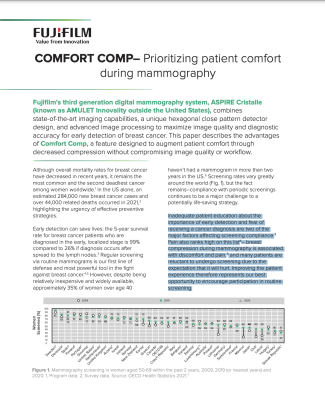
Fujifilm’s third generation digital mammography system, ASPIRE Cristalle (known as AMULET Innovality outside the United States), combines state-of-the-art imaging capabilities, a unique hexagonal close pattern detector design, and advanced image processing to maximize image quality and diagnostic accuracy for early detection of breast cancer. This paper describes the advantages of Comfort Comp, a feature designed to augment patient comfort through decreased compression without compromising image quality or workflow.

Although overall mortality rates for breast cancer have decreased in recent years, it remains the most common and the second deadliest cancer among women worldwide. In the US alone, an estimated 284,000 new breast cancer cases and over 44,000 related deaths occurred in 2021, highlighting the urgency of effective preventive strategies.

Early detection can save lives: the 5-year survival rate for breast cancer patients who are diagnosed in the early, localized stage is 99% compared to 26% if diagnosis occurs after spread to the lymph nodes. Regular screening via routine mammograms is our first line of defense and most powerful tool in the fight against breast cancer. However, despite being relatively inexpensive and widely available, approximately 35% of women over age 40 haven’t had a mammogram in more than two years in the US. Screening rates vary greatly around the world, but the fact remains–compliance with periodic screenings continues to be a major challenge to a potentially life-saving strategy.

Inadequate patient education about the importance of early detection and fear of receiving a cancer diagnosis are two of the major factors affecting screening compliance. Pain also ranks high on this list – breast compression during mammography is associated with discomfort and pain, and many patients are reluctant to undergo screening due to the expectation that it will hurt. Improving the patient experience therefore represents our best opportunity to encourage participation in routine screening.

Download the white paper.


Related Content

News | Women's Health

March 4, 2026 — QT Imaging Holdings recently announced that Mary W. Yamashita, MD will serve as medical advisor to the ...

Time March 06, 2026
arrow
News | Radiation Oncology

March 4, 2026 — Lunit has announced that 21 studies featuring its AI solutions will be presented at the European ...

Time March 05, 2026
arrow
News | Artificial Intelligence

March 2, 2026 — RadNet, Inc. has acquired Gleamer SAS, a radiology AI company based in Paris, France. Gleamer will be ...

Time March 03, 2026
arrow
News | Women's Health

Feb.23, 2026 — The first clinical patient received a Clairity Breast cancer risk score, marking a historic milestone in ...

Time February 23, 2026
arrow
News | Breast Biopsy Systems

Feb. 18, 2026 — Mammotome, a Danaher company, has introduced the Mammotome Prima MR Dual Vacuum-Assisted Breast Biopsy ...

Time February 18, 2026
arrow
News | Breast Imaging

Feb. 16, 2026 — Rising demand for breast cancer screening and diagnostics is outpacing the supply of available breast ...

Time February 17, 2026
arrow
News | Magnetic Resonance Imaging (MRI)

Feb. 5, 2026 — Eyas Medical Imaging, Inc. has received U.S. Food and Drug Administration (FDA) 510(k) clearance for its ...

Time February 06, 2026
arrow
News | Ultrasound Women's Health

Feb. 5, 2026 — BrightHeart, a global provider of AI-driven prenatal ultrasound, has announced the availability of its B ...

Time February 05, 2026
arrow
News | Radiation Therapy

Feb. 4, 2026 — On World Cancer Day (02.04.26), the American Society for Radiation Oncology (ASTRO) and the European ...

Time February 04, 2026
arrow
News | Radiology Imaging

Feb. 4, 2026 — The Royal College of Radiologists (RCR) has issued its initial reaction to the British government's ...

Time February 04, 2026
arrow
Subscribe Now