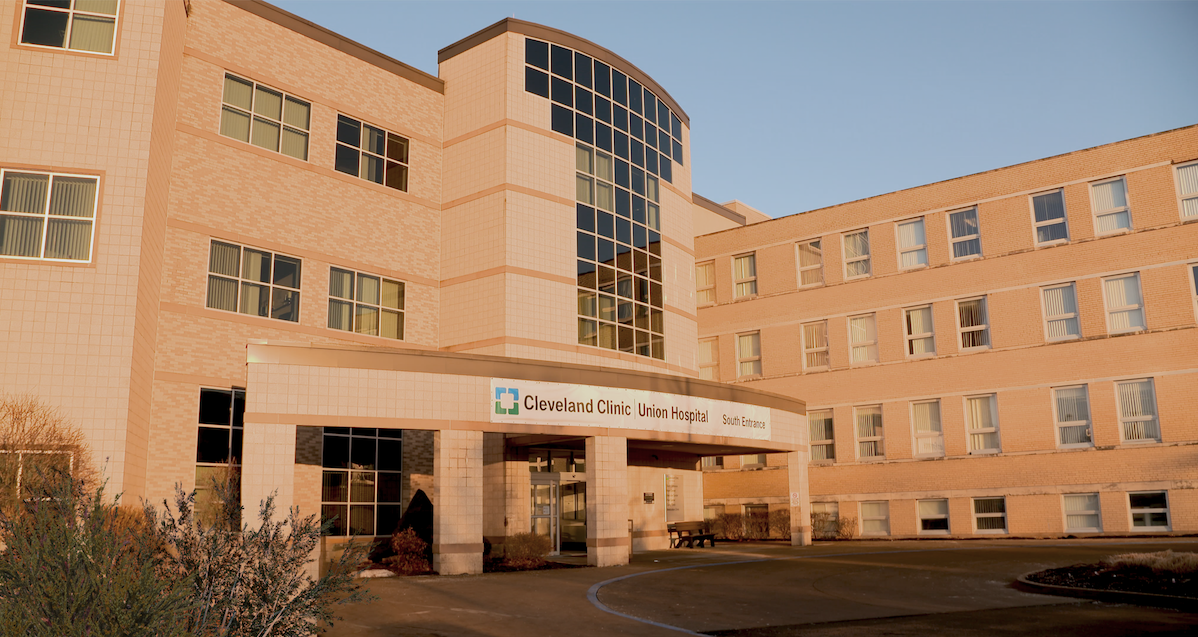
Cleveland Clinic Union Hospital
Cleveland Clinic Union Hospital (CCUH) has served the community of Ohio’s Tuscarawas Valley for more than 100 years. Although times have changed, the hospital remains devoted to ensuring the highest levels of patient care and the most advanced medical technologies and treatments for its patients.
The hospital is acclaimed for its successes in information security and technological sophistication, having earned multiple special recognitions in recent years. This recognition includes consecutive years on Becker’s Hospital Review’s 100 Great Community Hospitals list.
After years of growth, CCUH’s software could not keep up with the amount of data the hospital was generating — it needed a solution capable of consolidation and organization on a level that picture archiving and communication systems (PACS) could not achieve.
Jacqui Bianchi, IS application manager with CCUH, explained how the situation was creating inefficiencies and challenges, especially for physicians.
“Software has become a major player here. A physician wants to see the story brought together, to see the patient as a whole. They don’t want to see radiology and then have to look somewhere else for a mammography,” Bianchi said. “What Novarad has given us is the ability to look at all these different images together, not just from the current stay, but from past stays as well. In this industry, with every healthcare dollar being scrutinized, we’re spending our dollars wisely.”
EI’s Support for Comprehensive Patient Care
CCUH had been having some difficulties managing DICOM and non-DICOM images across multiple image-generating departments including radiology, wound care, ED, etc. Yet all of these images play a critical role in the care continuum. The inability to see all of them together has posed a unique problem for care providers, and for patients looking to become actively involved with their healthcare.
CIO David Baumgardner chose to illustrate this with a wound care comparison.
“In the wound center, every patient has a series of pictures. They make up progressive episodes of care for that patient. So, there’s a great loss of productivity if you don’t have a process in place that is efficient, doesn’t use a lot of staff time, and offers the convenience of finding those images when the doctors need to have that information at their fingertips. Storing those files securely is very important. Ensuring that only the right people have access to them, being able to track that access, and being able to have those pictures archived in an orderly way accelerates and improves the quality of the patient care we provide.”
The EI system manages a facility’s information by providing an efficient workflow for managing both DICOM and non-DICOM images throughout the hospital by transitioning the storage of images and patient information from hard drives, disks, disparate archives and USB drives to a vendor neutral archive.
Financial and Operational Implications
Though patient care might get the headlines, budget cannot be ignored — and software pricing must be investigated thoroughly. Fortunately, it is possible to plan pricing and calculate a swift return on investment (ROI) with enterprise imaging.
“The enterprise imaging solution offers a great ROI because you won’t be pursuing three or four different solutions,” Baumgardner said. “It can all be managed from our servers here — one server, one vendor, one solution, one interface.”
One of the common pitfalls of an image management strategy has always been having to manage multiple vendors and the issues associated with systems that don’t necessarily play well together. By implementing an enterprise imaging solution, CCUH has been able to avoid these problems and maintain greater control over its own data.
Novarad’s Ncompass Enterprise Imaging system also comes with a guaranteed total cost of ownership (TCO), which makes the planning process that much easier on both the hospital’s current budget and on its financial outlook years down the road.
Going a step beyond budget, operational efficiency could arguably have the greatest impact on care.
“The enterprise imaging approach is helpful for when a patient comes to the hospital for another service,” said Marcy Adkins, iOS applications analyst with CCUH. “If necessary, the provider or any end user can access Ncompass, to view any other images that the patient has had in the past.”
According to Baumgardner, its importance can’t be understated.
“Any time we can benefit the caregivers — any time we can make their day, workload or their workflow more efficient — it improves quality of care for the patients,” Baumgardner said.
Working Together for a Higher Standard of Care
When undertaking the grand task of upgrading your entire data management system, who you choose to work with is just as important as the product you choose. You don’t just want to work with a vendor, your goal should be to work with a partner.
“We’re working with Novarad — working with a partner — to implement tools that are fun to put in,” Baumgardner said. “And, you know, there are big wins from those for both the employee and patient, so these are always neat projects to work on.”
Cleveland Clinic Union Hospital plans to continue their high standard of patient care and advancing technology to serve their community and beyond. Implementation of Novarad’s Ncompass Enterprise Imaging System is only the first step on the hospital’s new path to the future.
Case study supplied by Novarad.
Related content:
Cleveland Clinic Union Hospital Selects Novarad for Enterprise Imaging Management

 September 21, 2026