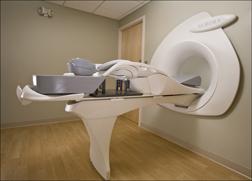
Aurora is one company that offers a breast MRI system.
May 23, 2012 — Magnetic resonance imaging (MRI) provides an indication of a breast tumor's response to pre-surgical chemotherapy significantly earlier than possible through clinical examination, according to a new study published online in the journal Radiology.
Women with breast cancer often undergo chemotherapy prior to surgery. Research has shown that women who receive this treatment, known as neoadjuvant chemotherapy, are more likely to achieve breast conservation than those receiving chemotherapy after surgery.
Clinicians track a patient's response to neoadjuvant chemotherapy through clinical measurements of the tumor's size and location. Contrast-enhanced MRI offers a promising alternative to the clinical approach through its ability to detect blood vessel formation in tumors, known as angiogenesis. Angiogenesis is an earlier and more accurate marker of tumor response.
“MRI was better than the clinical approach for predicting which patients would go on to have complete tumor response,” said Nola M. Hylton, Ph.D., professor of radiology and biomedical imaging at the University of California in San Francisco. “It gave us great information on early response to treatment.”
For the study, researchers analyzed data from ACRIN 6657, the imaging component of the multicenter Investigation of Serial Studies to Predict Your Therapeutic Response with Imaging And moLecular Analysis (I-SPY TRIAL) breast cancer trial.
They compared MRI and clinical assessment in 216 female patients ranging in age from 26 to 68 years undergoing neoadjuvant chemotherapy for stage II or III breast cancer. MRI sessions were performed before, during and after administration of a chemotherapy regimen. The researchers correlated imaging results with subsequent laboratory analysis of surgical samples.
MRI size measurements were superior to clinical examination at all time points, with tumor volume change showing the greatest relative benefit at the second MRI exam. MRI was better than clinical assessment in predicting both complete tumor response and residual cancer burden.
The study shows how imaging can play a vital role in characterizing a tumor and monitoring treatment response.
“What we see on imaging helps us define not just the size of the tumor but its biological activity,” Hylton said. “We can observe if the signal increases after contrast injection, and interpret that increase as angiogenic activity. We can also use water diffusion measurements with MRI to provide an indirect reflection of the density of the cells.”
Hylton and colleagues currently are assessing I-SPY data to see if MRI is better for predicting the likelihood of breast cancer recurrence. They expect to publish those results later this year.
For more information: http://radiology.rsna.org/

 October 09, 2026