News | Mammography | March 31, 2017

New data analysis shows nearly 275,000 breast cancer deaths have been averted since 1990, attributed to increased mammographic screening and improved therapies

breast cancer deaths, mammography screening, ACR, yearly decline

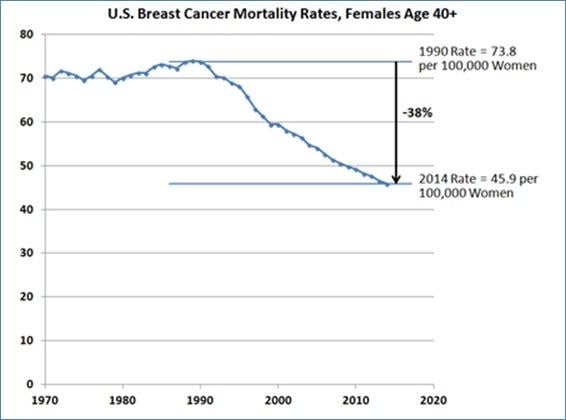
March 31, 2017 — A recent analysis of newly added 2014 data to the National Cancer Institute SEER database by R. Edward Hendrick, Ph.D., shows that the breast cancer death rate has now fallen 38 percent since 1990. This downward trend follows the increased use of mammography screening beginning in the mid-1980s. This decline amounts to 274,765 breast cancer deaths averted since 1990 — including 22,054 in 2014 alone.  

In 1990, 73.8 women per 100,000 women died of breast cancer. The newly-added 2014 SEER data shows that figure has dropped to 45.9 breast cancer deaths per 100,000 women. Prior to 1990, the breast cancer death rate had remained virtually unchanged since death rates were first recorded by SEER in 1969.

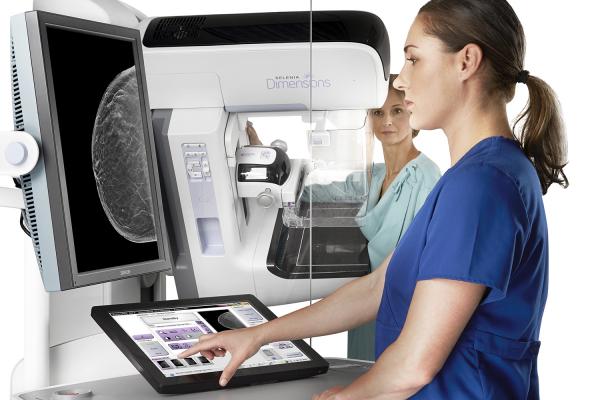
Regular mammography screening and improved therapies are undoubtedly responsible for the decline in breast cancer deaths, according to the research authors. Mammography can detect cancer early when it is most treatable and can be treated less invasively. This also helps preserve quality of life.

study published in Cancer showed that more than 70 percent of the women who died from breast cancer in their 40's at Harvard teaching hospitals were among the 20 percent of women who were not being screened. A study in the British Medical Journal shows that early detection of breast cancer — as with mammography — significantly improves breast cancer survival.

Major American medical organizations with expertise in breast cancer care, including the American Congress of Obstetricians and Gynecologists (ACOG), American College of Radiology (ACR) and Society of Breast Imaging (SBI) continue to recommend that women start getting annual mammograms at age 40.

For more information: www.mammographysaveslives.org

Related Content

News | Women's Health

March 4, 2026 — QT Imaging Holdings recently announced that Mary W. Yamashita, MD will serve as medical advisor to the ...

Time March 06, 2026
arrow
News | Radiation Oncology

March 4, 2026 — Lunit has announced that 21 studies featuring its AI solutions will be presented at the European ...

Time March 05, 2026
arrow
News | Artificial Intelligence

March 2, 2026 — RadNet, Inc. has acquired Gleamer SAS, a radiology AI company based in Paris, France. Gleamer will be ...

Time March 03, 2026
arrow
News | Women's Health

Feb.23, 2026 — The first clinical patient received a Clairity Breast cancer risk score, marking a historic milestone in ...

Time February 23, 2026
arrow
News | Breast Biopsy Systems

Feb. 18, 2026 — Mammotome, a Danaher company, has introduced the Mammotome Prima MR Dual Vacuum-Assisted Breast Biopsy ...

Time February 18, 2026
arrow
News | Breast Imaging

Feb. 16, 2026 — Rising demand for breast cancer screening and diagnostics is outpacing the supply of available breast ...

Time February 17, 2026
arrow
News | Magnetic Resonance Imaging (MRI)

Feb. 5, 2026 — Eyas Medical Imaging, Inc. has received U.S. Food and Drug Administration (FDA) 510(k) clearance for its ...

Time February 06, 2026
arrow
News | Ultrasound Women's Health

Feb. 5, 2026 — BrightHeart, a global provider of AI-driven prenatal ultrasound, has announced the availability of its B ...

Time February 05, 2026
arrow
News | Radiation Therapy

Feb. 4, 2026 — On World Cancer Day (02.04.26), the American Society for Radiation Oncology (ASTRO) and the European ...

Time February 04, 2026
arrow
News | Radiology Imaging

Feb. 4, 2026 — The Royal College of Radiologists (RCR) has issued its initial reaction to the British government's ...

Time February 04, 2026
arrow
Subscribe Now