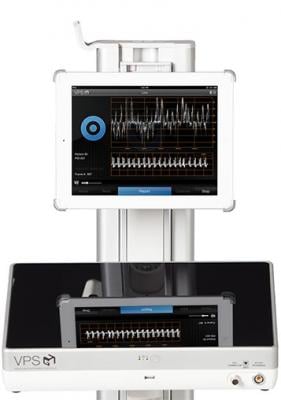
September 3, 2014 — Teleflex announced a newly published clinical study demonstrating the accuracy of the Arrow VPS G4 vascular positioning system, with placements of peripherally inserted central catheters (PICCs), can eliminate the use of confirmatory chest X-rays.
The peer-reviewed study, titled “Successfully Eliminating Chest Radiography by Replacing It with Dual Vector Technology and an Algorithm for PICC Placement,” appeared in the June 2014 issue of the Journal of the Association for Vascular Access (JAVA). The prospective, non-randomized research showed the VPS G4 system achieved 100 percent accuracy in placement of PICCs in an initial group of patients with normal sinus rhythm. When used in this study the device was also found to be useful in several patients who had atrial fibrillation.
Because the system enables accurate catheter placement, the study concluded, confirmatory chest X-rays can be eliminated when a steady Blue Bullseye is illuminated, which in turn reduces radiation exposure for patients, speeds the delivery of therapy and lowers direct costs.
The VPS G4 combines intravascular electrocardiogram (ECG), intravascular Doppler ultrasound and a unique software algorithm to accurately place catheter tips in the lower third of the superior vena cava (SVC) at the heart’s cavo-atrial junction (CAJ). The VPS G4 is cleared by the U.S. Food and Drug Administration (FDA) to eliminate chest X-ray in adult patients when a steady Blue Bullseye is achieved.
In the study, the system was used with 31 patients selected from the PICC patient population at Presence Saint Joseph Medical Center in Joliet, Ill. For purposes of the study, placement with the system was considered accurate if the result obtained with a steady Blue Bullseye was confirmed by a subsequent chest X-ray.
Of the 30 subjects, 25 had normal sinus rhythm. A steady Blue Bullseye was obtained for all 25 of those patients, an accuracy rate of 100 percent. Five patients in the study were diagnosed with atrial fibrillation. A steady Blue Bullseye was obtained for three of those patients. Although a confirmatory chest X-ray is required for patients with atrial fibrillation when using the VPS G4, this result was noteworthy, the study said, because some other positioning technologies cannot be used with patients who have an abnormal sinus rhythm. One of the patients was dropped from the study because of technical difficulties.
Based on these findings, Presence Saint Joseph Medical Center determined that when the positioning system is used for PICC placements in patients with normal sinus rhythm, a confirmatory chest X-ray is not necessary.
"Our experience with the positioning system has been empowering in multiple ways,” said Constance Girgenti, BSN, RN, VA-BC, lead author of the article and the vascular access coordinator at Presence Saint Joseph. “The system enables us to provide safer, timelier care for our patients, which is extremely important to us as clinicians. These excellent outcomes have continued, and it has been very satisfying to oversee the process from successful study to broader implementation.”
Elizabeth Donnellan, RN, BSN, VA-BC, co-authored the paper about the positioning system’s use at Presence Saint Joseph. “Our vascular access team is one of the few in the country that has also expanded its practice to place central venous catheters, or CVCs,” said Donnellan. “Now that we have established the effectiveness of the VPS G4 system for PICCs, we expect to start using it with central lines. Our next goal is to eliminate confirmatory chest X-rays with CVCs.”
The study results are important for several reasons:
- Reduced radiation exposure. If accurate placements can be made without relying on a confirmatory X-ray, patients are spared the exposure to the associated radiation.
- Avoidance of treatment delays. At many hospitals, it can take up to several hours to obtain a confirmatory X-ray, which delays treatment, and then have the X-ray read by a radiologist, which further delays treatment.
- Reduced costs. Confirmatory X-rays, which are read by radiologists, add costs. So do malpositioned catheter tips, which require adjustment of the line position. The positioning system can eliminate confirmatory chest X-rays in most cases and also minimizes catheter malpositions.
Teleflex provided no financial support for this study other than supplying the device for the initial trial. The lead author has provided consulting to Teleflex regarding technologies other than Arrow VPS G4.
For more information: www.teleflex.com

 October 07, 2026