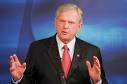
U.S. Rep. Parker Griffith (D-AL) told attendees: We are having a difficult time distributing healthcare into the rural areas, and imaging access to imaging access to primary care is absolutely essential.
July 13, 2009 - The Access to Medical Imaging Coalition (AMIC), today, echoed a key sentiment expressed by 40 House Democrats in a letter to the House Democratic leadership regarding regional disparities in Medicare reimbursement rates.
The Blue Dog Coalition, a group of moderate Democrats led by Arkansas Democratic Congressman Mike Ross, Rep. John Tanner, (D-TN), and Rep. Allen Boyd, (D-FL), sent their letter to Speaker Nancy Pelosi and Majority Leader Steny Hoyer late last night. Representatives of the coalition are scheduled to meet with House Energy and Commerce Chairman Henry Waxman, Ways and Means Chairman Charlie Rangel and Education and Labor Committee Chairman George Miller, today to discuss their concerns.
AMIC noted that regional reimbursement disparities already exist, and if imaging reimbursements are subject to another deep and arbitrary cut, seniors’ in rural regions of the country will experience severe access problems such as travelling long distances for appointments, lengthy waits for appointments, long lines in waiting rooms and office appointments at odd hours of the day, including late at night. This will unfortunately cause too many seniors to delay or forgo life-saving imaging services.
“Rural doctors and imaging facilities have long been forced to bear the brunt of regional disparities in Medicare reimbursement, as they have a far lower utilization rate than other areas,” said Tim Trysla, executive director, AMIC. “With Congress and the Administration looking at proposals to nearly double the Medicare utilization assumption, we are especially concerned about how disproportionate reimbursements for states with large rural populations will affect diagnostic care. Therefore, we are pleased to see policymakers, such as the Blue Dog Coalition, addressing disproportionate reimbursements.”
On June 24th, AMIC, in conjunction with the Colon Caner Alliance, Lung Cancer Alliance, and Susan G. Komen for the Cure Advocacy Alliance, briefed the Congressional Rural Caucus on the impact reimbursement cuts would have on rural health care. Joined by physicians and patient advocates from rural states, such as Iowa, Arkansas and Colorado, participants expressed their concerns with proposals to enact deep Medicare cuts through altering the Medicare formula.
At the Rural Caucus briefing, U.S. Rep. Parker Griffith (D-AL) told attendees: “We are having a difficult time distributing healthcare into the rural areas, and imaging – access to imaging – access to primary care is absolutely essential.”
“It is so important that we really look at what impact these decisions will have on our rural partners,” said Alison Levin, Executive Director of the Ozark Affiliate - Susan G. Komen for the Cure, one of the briefing’s panel speakers at the event. “In some of our rural communities, the book mobile comes around more than the mobile mammography units.”
“The average rural imaging center uses its equipment about 48 percent of the time,” added Dr. James Borgstede, the former chair of the American College of Radiology’s rural practice committee. “This proposal, which will ramp up utilization expectation upwards of 90 percent, will drive a number of imaging centers out of business.”
AMIC has endorsed proposals to promote adherence to appropriateness criteria for imaging services. The designation of nationally recognized, physician-developed appropriateness criteria together with an education and confidential feedback program to report patterns of adherence to those criteria will provide the Centers for Medicare and Medicaid Services (CMS) with necessary information to limit inappropriate imaging while maintaining patients’ access to needed imaging services.
AMIC also strongly supports the establishment of a nationwide Diagnostic Imaging Exchange Network (DIEN) that would allow physicians to access a patient’s past imaging studies in order to determine the necessity, safety and appropriateness of ordering a new scan. A DIEN would produce savings to the Medicare program by eliminating many duplicative scans while improving patient safety through the reduction of radiation exposure. AMIC also supports the transparency in self-referrals policy proposal that would require that physicians disclose their financial interest in pre-identified imaging services.
For more information: www.acr.org
 October 19, 2026