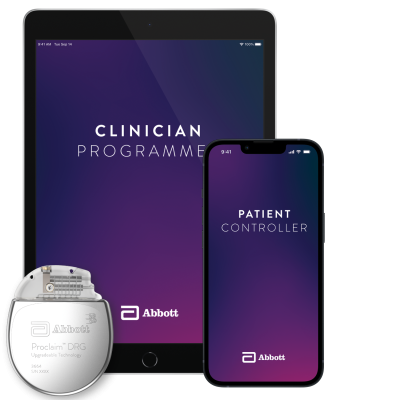
January 18, 2024 — Abbott announced that the U.S. Food and Drug Administration (FDA) has approved expanded MRI labeling for its dorsal root ganglion (DRG) stimulation therapy, the Proclaim DRG neurostimulation system, which allows patients to receive full-body MRI scans while implanted with the device.2* The Proclaim DRG neurostimulation system is the only FDA-approved DRG technology, providing targeted relief for people with complex regional pain syndrome (CRPS) types I and II of the lower limbs by stimulating the DRG, which are clusters of nerve cells found along the spine.3
CRPS is a rare and painful condition that affects about 200,000 people in the U.S. each year.4 Characterized by a constant or intermittent burning, stinging or tearing sensation, CRPS has been found to be more excruciating than childbirth or amputation of a limb.5 For people who suffer from the syndrome and struggle to control the pain, Proclaim DRG stimulation can be an effective option, as four out of five people who receive the therapy experience significant pain relief and improved quality of life.6
MRI is one of the most widely used technologies to create detailed images of the inside of the body to inform diagnoses and treatment approaches for people with chronic pain.7 MRIs can be used to help assess the progression of CRPS.8 In these situations, an option like the Proclaim DRG therapy, which allows patients to receive MRI scans anywhere in the body within approved parameters, can be invaluable to the patient and radiologist.
"The ability to do full-body MRI scans with the Proclaim DRG neurostimulation system means that, as physicians, we can ensure that people are receiving the care they need in a timely manner because they aren’t having to search for a facility that can accommodate special MRI settings for their device," said Timothy Deer, M.D., DABPM, president and chief executive officer of the Spine and Nerve Centers of the Virginias in Charleston, W.Va. "With these expanded MRI capabilities, we no longer need to sacrifice superior pain relief and quality of life outcomes in exchange for MRI needs."
With the expanded MRI labeling, Abbott’s Proclaim DRG neurostimulation system will offer:
· Full-body scans for new and existing patients^, providing near and long-term flexibility for their imaging needs
· Safe scanning of any body part with standard MRI scanners^, making finding an imaging center easier and more straightforward for patients and doctors
· Compatibility with 50cm SlimTip DRG leads
"As we continue to work holistically across chronic pain care, we’re excited to see this new MRI expanded indication for our proprietary and unique Dorsal Root Ganglion Stimulation therapy become another valuable tool in the hands of treating physicians helping people get back to living a life on their terms," said Pedro Malha, vice president, neuromodulation, Abbott.
For more information: www.abbott.com
References:
1Abbott. Survey on MRI labeling. Completion date: February 1, 2023; Austin, Texas. N = 25.
2 U.S. Food and Drug Administration. See https://www.accessdata.fda.gov/scripts/cdrh/cfdocs/cfpma/pma.cfm?id=P150004S063.
3 Abbott. Proclaim DRG Neurostimulation System Clinician’s Manual. Plano, TX. 2018.
4 National Organization of Rare Diseases. Feb. 8, 2023. Complex Regional Pain Syndrome. https://rarediseases.org/rare-diseases/reflex-sympathetic-dystrophy-syndrome/. Accessed Nov. 8, 2023.
5 Lee DH, Noh EC, Kim YC, et al. Risk Factors for Suicidal Ideation among Patients with Complex Regional Pain Syndrome. Psychiatry Investig. 2014;11(1):32-38. https://www.ncbi.nlm.nih.gov/pmc/articles/PMC3942549/
6 Deer TR, Levy RM, Kramer J, et al. Dorsal root ganglion stimulation yielded higher treatment success rate for complex regional pain syndrome and causalgia at 3 and 12 months: a randomized comparative trial. Pain. 2017;158(4):669-681. https://pubmed.ncbi.nlm.nih.gov/28030470/
7 Martucci, K., Ng, P., & Mackey, S. (2014). Neuroimaging chronic pain: what have we learned and where are we going?. Future neurology, 9(6), 615–626. https://doi.org/10.2217/fnl.14.57
8 Stanford Medicine. Complex Regional Pain Syndrome (CRPS). https://med.stanford.edu/pain/about/chronic-pain/crps.html Accessed. Nov. 8, 2023.
 October 19, 2026