Advances in the growing radiation dose management market are continually helping those who administer treatment to focus on personalized patient care and workflow management.
Estimated to be worth $343 million in 2023, the market is poised to reach $654 million by 2028, driving a CAGR of 13.8% from 2023-2028, according to a report by MarketsandMarkets. Analysts identified key growth drivers, led by “a surge in the utilization of medical imaging modalities, propelled by a rising incidence of chronic diseases.” The authors shared insight — echoing what radiation oncologists have shared with our editorial team over the past year: “As healthcare demands increase, the prevalence of diagnostic and interventional procedures involving ionizing radiation, such as X-rays and CT scans, is on the rise. Additionally, there is a growing awareness regarding radiation dose management practices among healthcare professionals and patients, further emphasizing the need for comprehensive solutions. The convergence of these factors, including the use of medical imaging, increasing awareness of radiation risks, increasing prevalence of chronic diseases, and the growth in radiology equipment installations, collectively contribute to the growth of the radiation dose management market in the forecast period.”
Not surprisingly, oncology has accounted for the largest market share for the past five years. With increased focus on personalized treatment, doctors and vendors alike are tailoring treatments. Evident, from leaders in the field, is a growing emphasis on personalized medicine in oncology, with treatments tailored to individual patients. This, as noted by the MarketsandMarkets researchers, “necessitates precise and individualized radiation dose planning and management, driving the demand for advanced solutions within the oncology segment.”
View the Radiation Dose Management Comparison Chart here
Vendor Offerings Support Key Needs
A look at some of the latest advances in radiation dose management sheds light on the ways vendors are answering the call to support both patients and their care teams.
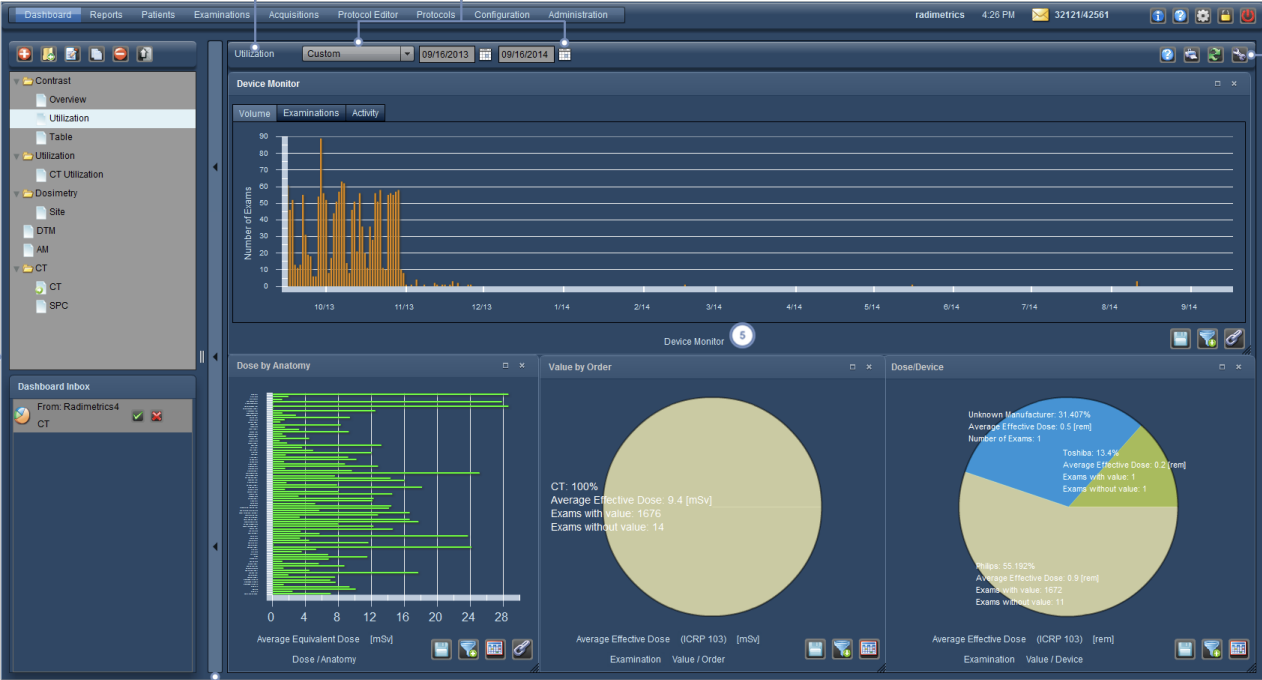
Radimetrics is Bayer’s contrast dose management platform which offers support from the point of care through to post procedure, helping to automate manual processes, directly impacting key areas of the complete radiology workflow. In describing its Radimetrics v3.0, Bayer reported that the latest evolution of its enterprise dose management application was designed to support many of the latest accreditation standards on dose reporting and tracking, protocol management, and benchmarking, while helping patient-care teams report, track, and manage radiation dose and contrast dose throughout the chain of care with increased functionality.
Dennis Durmis, Head of Bayer’s Radiology Americas, said the launch represented “an important advancement in utilizing digital platforms for analyzing data to optimize standardization, and problem-solve in real time.” The interface design, capabilities, and comprehensive training approach, Durmis forecasted, would “drive standardization for personalized care for patients.” The system reduces repetitive, manual documentation, and dictation for more efficient radiology workflows, and helps to accelerate reporting via automatic outbound interfaces to PACS, RIS and speech reporting (SR), among other benefits that measure operational quality.
Teamplay Dose from Siemens Healthineers provides easy access to dose data, supports the quality assurance process for monitoring imaging radiation dosage, and offers additional advantages, including lower infrastructure and maintenance costs and benefits from continuous feature releases.
Siemens Healthineers reports the system is an advanced, cloud-based dose management solution which simplifies tasks from data processing to analytics and reporting. Relevant dose data is accessible in a convenient manner for the entire fleet of radiation-emitting imaging devices. A patient-centric dose monitoring solution, it allows users to view dose values and all performed examinations for an individual patient, and to also drill down to a single scanner or identify protocol settings that need to be improved. The company offered additional value-add features, noting: “Visualized in a separate alert management page, teamplay Dose makes it easy to detect dose events which exceed institutional or national reference levels, its underlying root cause and thus, facilitates compliance with national regulations. By offering various integration abilities to external systems like the RIS, reporting systems or national registries, it contends that teamplay Dose seamlessly interfaces with your existing IT infrastructure.”
Mirion Technologies made news in Nov. 2023 when it debuted its new Instadose VUE personal dosimeter, from its Dosimetry Services brand, during the Radiological Society of North America (RSNA) Annual Meeting and Scientific Sessions. The company reported the advanced, wireless personal dosimeter provides fast exposure reporting and dosimeter status feedback, making exposure tracking and compliance easier, and offers a display screen for improved user engagement, insights, and compliance. By harnessing Bluetooth Low Energy Technology, it enables administrators and wearers to capture and track personalized dose reads on-demand.
As evidenced in the market analysis and seen in the detailed Comparison Chart, the growth of the market and the advanced innovations combine to forecast strong support for oncology teams and their patients moving forward.

 October 08, 2026