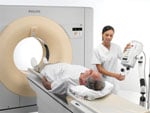
The Philips Brilliance iCT 256-slice scanner can perform a full body scan in less than a minute and exposes patients to 80 percent less radiation than traditional 64-slice CT machines. The speed of the system helps freeze motion and reduce artifacts.
Advancements in newer 64-slice computed tomography (CT) and the introduction of 256- and 320-slice systems are helping to significantly reduce patient exposure to ionizing radiation.
In 64-slice cardiac imaging, between four and 16 images are taken and stitched together to create a full image of the heart. To create seamless images without gaps, each scan overlaps the previously scanned area by as much as 80 percent, said Michael Poon, M.D., FACC, professor of medicine and radiology, director of advanced cardiac imaging, Stony Brook University Medical Center, Stony Brook, N.Y. He said the number of images that are needed and the required overlap adds up to a lot of additional patient radiation exposure. The number of images and overlap is significantly reduced or eliminated with 256- and 320-slice systems.
The speed of the new high-slice systems and the large area of coverage in each scan also help eliminate motion blur associated with pediatric patients, or patients with fast heart rates or who cannot hold their breath.
320-slice CT
Poon said the single, large volume of the Aquilion One 320-slice system allows for a big reduction in radiation because its 16 cm imaging area can image the whole heart in one scan. This eliminates stitching images or overlap imaging.
Contrast dose is also reduced with the 320-slice scanner, since only one scan is required, instead of several over several seconds. Poon said an average 80-90 cc contrast dose is used for 64-slice exams, because of the duration and number of images taken. Stony Brook Medical Center reduced this amount to as low as 50 cc with the Aquilion One.
With less radiation, lower contrast usage, fast speed, a patient weight limit of up to 600 pounds and versatility to image any patient for nearly any condition, Poon said he can’t think of any downside to the technology, other than its price.
256-Slice CT
The Brilliance iCT 256-slice scanner can perform a full body scan in less than a minute, and Philips says it exposes patients to 80 percent less radiation than traditional 64-slice CT machines.
The University of Chicago Medical Center’s older 64-slice scanners use retrospective gating. This technique keeps the X-ray source on for the entire scan, and ECG data is used to select the best images to stitch together. However, “You get a whopping dose,” said Michael Vannier, M.D., FACR, professor of medicine at the University of Chicago Medical Center.
The center purchased a Brilliance iCT, which images a larger volume, so only about two images are needed for stitching with less image overlap. The gantry speed is also much faster, helping to reduce motion artifacts. “The doses are reduced dramatically,” Vannier said.
He explained the system also has a setting for 100 kV, which helps lower the dose. The 64-slice systems only have settings for 120 and 140 kV.
Lowering 64-Slice Dose
The GE Healthcare CT750 HD scanner can help reduce dose by up to 83 percent for cardiac scans. That claim was confirmed by James Min, M.D., director of the cardiovascular CT lab at New York Presbyterian Hospital and assistant professor of radiology at Weill Cornell Medical College. He said the system helped lower the cardiac patient dose from an average of 5.5 millisieverts (mSv) to an average of 1.2 mSv. This includes all types of patients. Forty percent of these patients, with a smaller body size, receive doses of less than 1 mSv.

 October 08, 2026