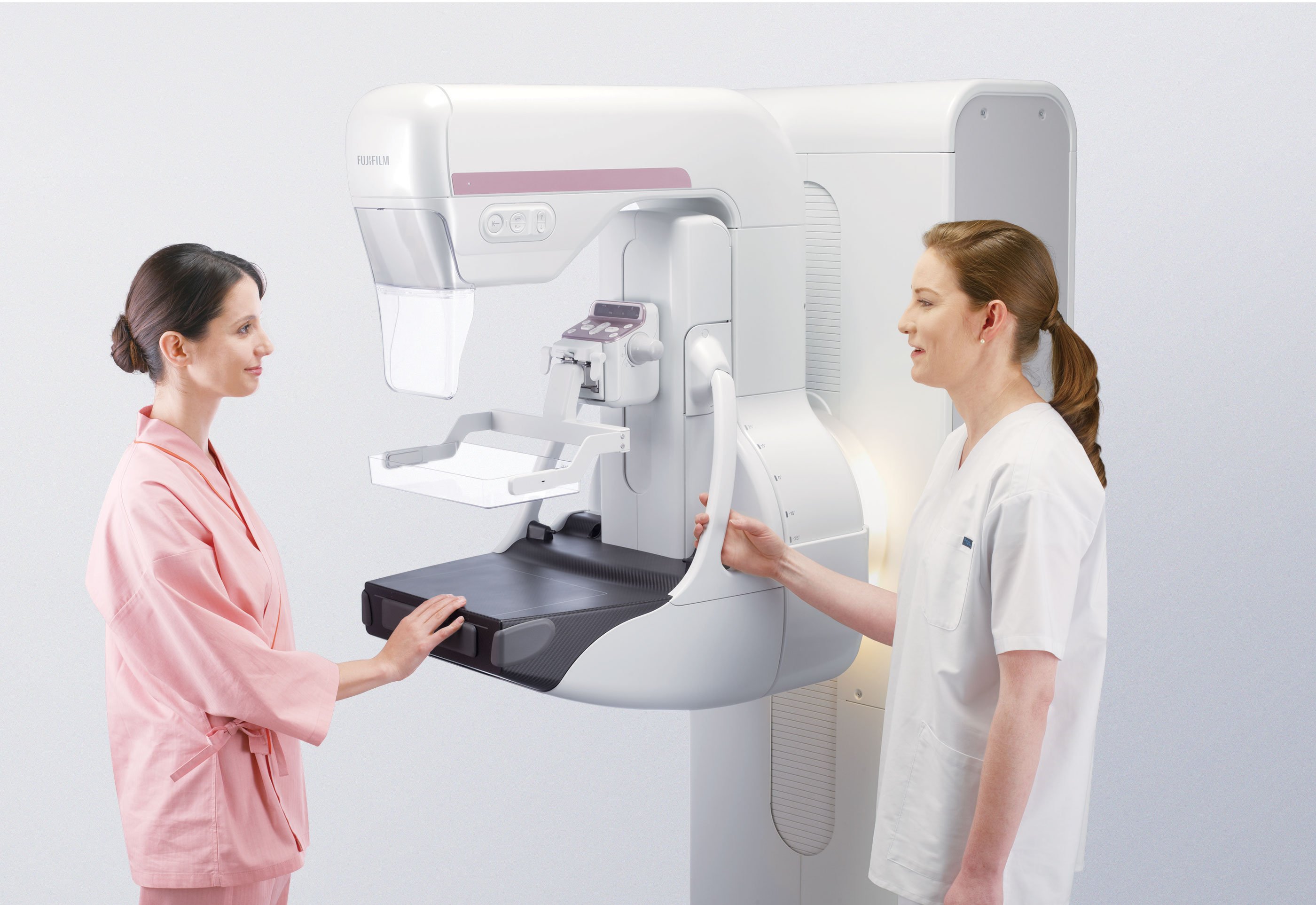
Image courtesy of Fujifilm.
May 14, 2018 — On April 9, 2018, the U.S. Food and Drug Administration (FDA) announced that all four of its Mammography Quality Standards Act (MQSA) accrediting bodies are approved to accredit digital breast tomosynthesis (DBT) systems. This includes the states of Arkansas, Iowa and Texas, and the American College of Radiology (ACR).
In the medical device world, the constant evolution of technology continues to provide new and improved diagnostic and therapeutic tools, and the mammography world is no exception. On Feb. 11, 2011, the fourth generation of mammography technology emerged with FDA’s approval of the first DBT unit for U.S. marketing. At that time, just like when the first full field digital mammography (FFDM) unit was approved for marketing in January 2000, the FDA’s approved accrediting bodies (ABs) did not have standards developed or processes in place to accredit a new technology that was just introduced to the mammography community. Therefore, the FDA had to develop a stop-gap, temporary program — namely the FDA Certificate Extension Program. In the absence of accreditation, this program’s purpose was to provide a temporary way for new technology approved for marketing to be legally used under the MQSA, so that it could benefit patients while accreditation programs were being developed.
The MQSA mandates that facilities be accredited. Once ABs are ready to accredit a new technology, apply to FDA, and are approved, the transition from a certificate extension program to an accreditation program occurs. Such was the case with FFDM in February of 2003 and now again for DBT.
The FDA has worked and continues to work closely with the accrediting bodies to assist facilities with this transition. Individual accrediting bodies have established their own accreditation procedures and transition mechanisms within the confines of the MQSA requirements for accreditation. The FDA continued to accept applications up until April 6, 2018. Any facility granted an extension of its certificate to include the use of a DBT unit to date, or who is granted one on an application received by FDA by April 6, can continue to use its existing DBT unit(s) under that certificate extension while transitioning to being accredited by its accreditation body. If a facility with a current DBT certificate extension adds a new unit and wants to use the DBT modality on the new unit, the facility must now apply to its accreditation body to have that new unit accredited. All other facilities, and those certificate extension facilities that acquire DBT units after the April 6, 2018 cutoff date, must contact their respective ABs to apply for accreditation.
Although housed in a single unit, due to the differences in technology between FFDM and DBT, the FFDM and DBT components of the mammography system need to be accredited as two separate units if the facility uses the DBT component in clinical practice. And even if a facility uses only the DBT component of a mammography system, and not the FFDM mode, both the FFDM and DBT systems must be accredited, as accreditation of the DBT modality relies on documenting the proper functioning of certain aspects of the FFDM system. As when the Certificate Extension Program was in effect, both the FFDM and DBT portions of a unit will each individually require inspection during the annual MQSA inspection process.
To further assist facilities with the DBT accreditation process, the table below summarizes the system components, quality control (QC) tests and new modality training requirements that are evaluated during the accreditation process:
| Facility System | Facility Intended Use of System | Accredit FFDM System? | Accredit DBT System? | Required Quality Control (QC) | Personnel training Requirements |
| FFDM system with DBT capability | FFDM (2-D) ONLY | Yes | No | FFDM QC Only | 8 hours of FFDM training only |
| FFDM (2-D), DBT (3-D) | Yes | Yes |
FFDM OC DBT QC |
8 hours of FFDM training and 8 hours of DBT training | |
| DBT (3-D) ONLY | Yes | Yes |
FFDM QC DBT QC |
8 hours of FFDM training and 8 hours of DBT training | |
| DBT Only System | Currently, there are no DBT (3-D) systems approved for U.S. marketing that do not have an FFDM (2-D) component | ||||
As noted in the table above, all personnel who perform DBT exams (technologists), interpret DBT images (interpreting physicians) or evaluate DBT units (medical physicists) must have at least 8 hours of training in FFDM and 8 hours of training in DBT. Facilities are required to complete the required quality control testing depending on the clinical use of the unit.
While there was no charge for the temporary FDA Certificate Extension Program, facilities will now incur fees for DBT accreditation, as they do for other types of mammography accreditation. Fees are set by each AB and vary among them. The justifications for each AB’s fees are evaluated and approved by the FDA.
The accrediting bodies are the best source of information about the DBT transition to accreditation and the specifics of their DBT accreditation requirements and processes; their links are provided below:
-
Facilities may also contact the MQSA Hotline at 800-838-7715 or by e-mail at [email protected].
For more information: www.fda.gov
 October 09, 2026