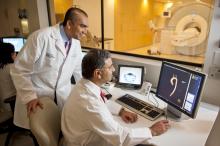
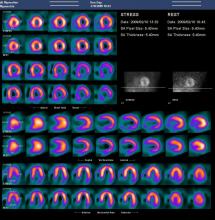
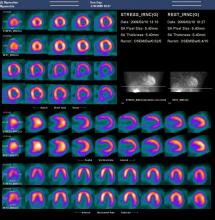
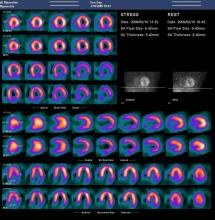
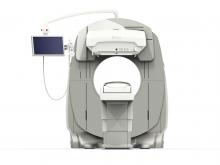
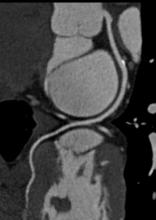
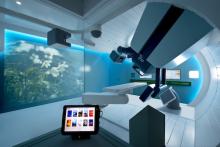
Accurate estimation of radiation absorbed dose in radioimmunotherapy (RIT) based on state-of-the-art 3-D imaging could lead to more personalized and effective treatments to improve non-Hodgkin lymphoma (NHL) patients’ chances of living longer without progression of their cancer, said researchers at the Society of Nuclear Medicine and Molecular Imaging’s 2013 Annual Meeting.

Supercharge processing productivity. EVP Plus image processing accelerates the capture set-up process and increases output quality. It provides greater efficiency and supports enhanced patient diagnosis. Download white paper to learn more.


When prostate cancer makes a comeback, it becomes increasingly important to have exceptional imaging available to find all possible regions where cancer has spread to other parts of the body, or metastasized, in order to plan the best possible treatment. A relatively new imaging system that simultaneously combines positron emission tomography and magnetic resonance (PET/MR) demonstrates a higher capacity for mapping recurrent prostate cancer than the already high standard of integrated PET and computed tomography (PET/CT), say researchers presenting a study at the Society of Nuclear Medicine and Molecular Imaging’s 2013 Annual Meeting.


One of the biggest hurdles of hybrid positron emission tomography and magnetic resonance (PET/MR) imaging is the prevalence of motion artifacts—blurring and ghostly visual anomalies caused by patient motion on the table during imaging. An MR technology has now been designed for PET/MR that employs tiny radiofrequency solenoids—metal coils integrated into hardware placed on the body—to track motion from those who do not or cannot stay put. Special software can then use the additional information provided by the coils to optimize the image, according to research being revealed at SNMMI’s 2013 Annual Meeting.

Intelerad Medical Systems announced the formation of a new Clinical Decision Support (CDS) Group. The Toronto-based group is made up of developers who will focus on adding evidence-based decision support and data mining features to Intelerad’s solution portfolio.

The Society of Nuclear Medicine and Molecular Imaging’s 2013 Annual Meeting marks the unveiling of the successful application of a new preclinical hybrid molecular imaging system—single photon emission tomography and magnetic resonance (SPECT/MR)—which has exceptional molecular imaging capabilities in terms of potential preclinical and clinical applications, technological advancement at a lower cost, and reduction of patient exposure to ionizing radiation.


For patients with advanced breast cancer, positron emission tomography (PET) and magnetic resonance (MR) imaging can improve quality of life and survival by providing physicians with information on the effectiveness of chemotherapy prior to surgery, say researchers presenting at the 2013 Annual Meeting of the Society of Nuclear Medicine and Molecular Imaging.


HIMSS Analytics recognizes six Legacy Health hospitals, and their ambulatory clinics, located in Portland, Ore. and Vancouver, Wash., with the HIMSS Stage 7 Award, and Stage 7 EMR Ambulatory Award.


Laurel Bridge Software's Navigator enterprise medical image fetcher, Navigator allows medical professionals to automate priors fetching, consolidate worklists, monitor unlimited MWLs or HL7 feeds, and support unlimited DICOM sources and destinations.

The Medical Image Workflow Manager is an event-driven workflow manager for the enterprise. The Medical Image Workflow Manager allows physicians to monitor and automate the transfer of images, records, priors, etc., based on HL7 messages, worklist events, time, or other events.

For more information: www.laurelbridge.com


Subscribe Now