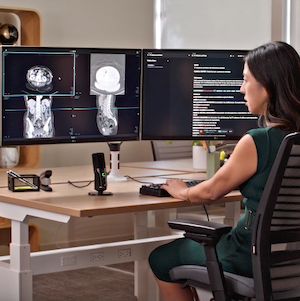
Photo: Mosaic Clinical Technologies
June 9, 2026 — Mosaic Clinical Technologies, a wholly owned subsidiary of Radiology Partners, has launched Mosaic Reporting, a new class of AI-native radiology reporting solution available as part of MosaicOS. Mosaic Reporting is already deployed to thousands of radiologists through Radiology Partners-affiliated practices, giving Mosaic a scaled real-world environment to refine and expand the platform.
Powered by foundation models developed by Cognita Imaging, the AI division of Mosaic Clinical Technologies, the patent-pending system that helps construct radiology reports in real time as radiologists interpret medical images. Mosaic Reporting works alongside the radiologist during interpretation in real time — organizing findings, structuring reports and enabling targeted edits within the reporting workflow. This capability is made possible by in-house developed foundation models that offer improved speed and accuracy compared to third-party models.
“Radiology is facing a chronic shortage of radiologists as imaging volumes continue to climb, leaving radiology practices, departments and the health systems that depend on them with growing backlogs and turnaround time pressure,” said Mike Peresie, president of Mosaic Clinical Technologies. “Mosaic Reporting is designed to help healthcare organizations create reading capacity, improve turnaround times and better meet service levels that referring physicians and patients expect. Because it is built as part of MosaicOS, organizations can see those gains immediately on a platform that continues to expand.”
Mosaic Reporting
Mosaic Reporting is purpose-built for radiology workflows and enables:
-
Real-time, AI-assisted report creation as radiologists dictate
-
Intelligent extraction of findings from natural speech and automatic placement into appropriate report sections
-
A natural dictation experience designed to reduce interruptions and cognitive load
-
Targeted, efficient editing and structured reporting with voice-directed editing
-
Fewer clicks and automated tasks, allowing radiologists to stay focused on clinical decision-making
-
Replacement of legacy reporting solutions
“Most AI documentation tools are built around clinician-patient conversations, but radiologists interpret images, which demands a fundamentally different approach,” said Adrit Rao, technical product lead at Cognita Imaging, the AI division of Mosaic Clinical Technologies. “Mosaic Reporting is one of the first new and significantly advanced approaches to radiology reporting in more than a decade. We worked closely with radiologists to design a reporting experience where AI works in real time as they read, with targeted edits and structured output that reduce friction and keep clinical decision-making at the center.”
For healthcare organizations facing rising imaging demand, staffing constraints, backlogs and pressure to improve turnaround times, Mosaic Reporting is designed to help expand clinical capacity and create a more efficient reporting environment without adding unnecessary complexity.
“This technology creates a more intuitive and effective reporting experience, helping radiologists reduce cognitive burden and focus on the patient,” said Dr. Nina Kottler, Chief Medical AI Officer at Mosaic Clinical Technologies. “For health systems, it creates an opportunity to unlock capacity, improve consistency and build a future-ready foundation that can evolve with their needs.”
A product video that showcases the real-time report construction experience is available here.

 October 07, 2026