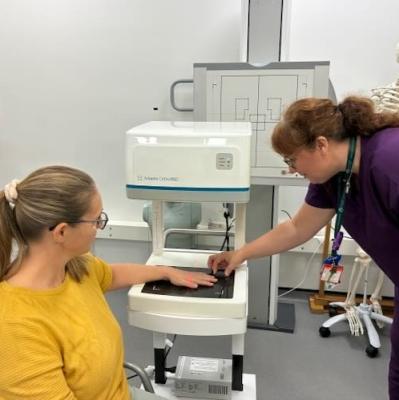
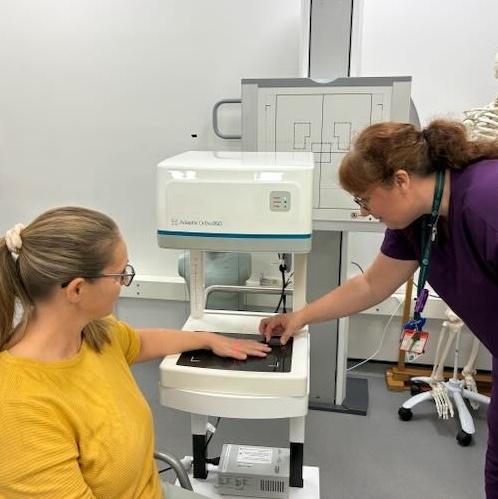
Emma Carnell becomes the first patient to take part in Adaptix/University of Exeter clinical trial. (Photo: Adaptix)
Oct. 22, 2025 — Imaging technology company Adaptix has begun live imaging trials as part of a research program at the University of Exeter.
Patients suspected of having rheumatoid arthritis will be the first in the Untied Kingdom to use Adaptix Ortho350 technology to help diagnose and track the progression of the disease in their hands. The new, portable imaging technology offers 3D imaging at a similar cost and radiation dose to traditional 2D X-rays and it is hoped that the more-detailed images it produces will support clinicians to speed up diagnosis and improve ongoing management of the condition.
Dr. Siân Phillips, Chief Medical Officer at Adaptix, said: “Up to 30% of people with early rheumatoid arthritis are missed when diagnosed using 2D X-rays, but more-detailed 3D imaging - such as MRI and CT scans — is expensive and waiting lists can be long.
“The compact design and lower radiation and power requirements of the Adaptix Ortho3D make 3D imaging much more accessible for clinicians and patients alike. These new trials mark an exciting new stage of our journey, not only delivering a clinical assessment of its effectiveness when compared to traditional 2D X-ray modalities, but also proves our range of clinical use cases from diagnostics to assessing disease progression.”
Adaptix’ imaging technology is already in use across multiple testing sectors, and has also delivered positive results in human cadaver trials. The trial, which is funded by Innovate UK, will evaluate the performance of Adaptix’ 3D imaging technology when compared to traditional 2D X-rays. It will look at three main areas: Diagnostic potential; Effective measurement of joint spaces; and evaluation of bone density — all in patients with inflammatory arthritis.
Professor Karen Knapp, director of Muscoskeletal Imaging at the University of Exeter, who is leading the trial, said: “The Adaptix Ortho350 promises much greater visualization of bone and joints than traditional 2D images, meaning the signs of arthritic inflammation and subtle changes, such as joint erosion — could be picked up and managed at an earlier stage than is often the case.
“The Adaptix Ortho350 promises much greater visualization of bone and joints than traditional 2D images, meaning the signs of inflammation and subtle changes, such as joint erosion - could be picked up and managed at an earlier stage. This trial is an excellent example of a partnership between our university and industry directly benefiting patients.
“Our trial will focus on adults with suspected rheumatoid arthritis of the hand, with participants being scanned with both the Adaptix Ortho350 and traditional 2D X-rays to assess and compare each imaging modality’s performance.“
The trial is supported by the Royal Devon University Healthcare NHS Foundation Trust, with participants recruited from the Rheumatology service. Support is also being provided from and the NIHR Exeter Biomedical Research Centre. for their contributions.”
For further information, visit: www.adaptix.com.

 October 08, 2026