News | Prostate Cancer | July 22, 2025

An accepted manuscript published in the American Roentgen Ray Society’s American Journal of Roentgenology  looks at how artificial intelligence can improve diagnostic consistency and reduce false-positives in prostate cancer detection.

Lesion Identification by AI and Histopathologic Annotation

July 16, 2025 — Artificial intelligence can improve diagnostic consistency and reduce false-positives in prostate cancer detection, according to an accepted manuscript published in the American Roentgen Ray Society’s American Journal of Roentgenology (AJR).

Noting enhanced clinical utility for radiologists, “AI may enhance consistency and reduce false-positives in prostate biparametric MRI (bpMRI) interpretation,” clarified AJR corresponding author Baris Turkbey, MD, from the National Cancer Institute and National Institutes of Health in Bethesda, MD. “Further optimization is required to improve sensitivity without compromising specificity.”

Turkbey et al.’s multireader, multicenter study used a balanced incomplete block design for MRI randomization. Six radiologists of varying experience interpreted bpMRI scans with and without AI assistance in alternating sessions. The reference standard for lesion-level detection for cases was whole-mount pathology after radical prostatectomy; for control patients, negative 12-core systematic biopsies. In all, 180 patients (120 case group, 60 control group) who underwent mpMRI and prostate biopsy or radical prostatectomy between January 2013 and December 2022 were included. The AJR authors then assessed lesion-level sensitivity, PPV, patient-level AUC for clinically significant prostate cancer and prostate cancer detection, and interreader agreement in lesion-level PI-RADS scores and size measurements.

Ultimately, AI-assisted bpMRI interpretation improved lesion-level PPV for prostate cancer (PI-RADS ≥ 3: 80.9% vs. 69.4%, p < .001) and significantly enhanced interreader agreement for PI-RADS scoring (κ = 0.748 vs. 0.336, p < .001) but slightly reduced sensitivity.

A supplement to this AJR manuscript is available online.
 

Lesion Identification by AI and Histopathologic Annotation
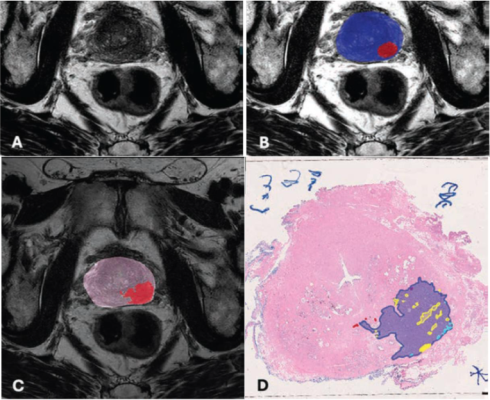
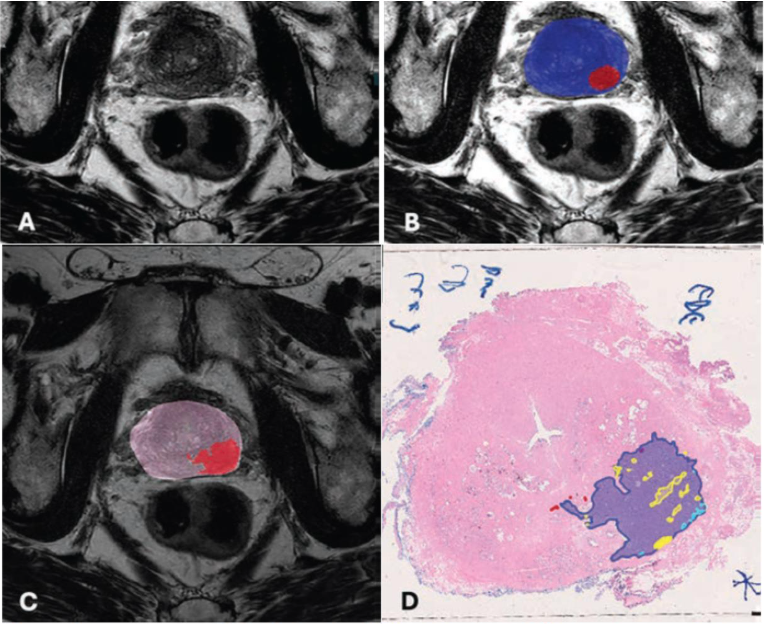
77-year-old man with serum PSA of 17.8 ng/mL. A) T2-weighted (T2W) MRI shows hypointensity in the left posterolateral peripheral zone. B) AI segmentation map overlaid on T2W image shows predicted prostate segmentation boundary in blue and PCa-suspicious lesion prediction segmentation in red. C) Ground truth histopathology slide registered to MR image shows annotated lesion segmented in red. D) Histopathologic annotation of whole mount prostate tissue after radical prostatectomy. This patient was found to have Gleason 4+3 disease in the region marked in blue. Yellow outlines represent cribriform architecture, red represents regions of Gleason 3, and light blue represents areas of lymphovascular invasion.


Related Content

News | Advanced Visualization

Nov. 20, 2025 — Avatar Medical and Barco have launched Eonis Vision, marking a new evolution in how medical imaging is ...

Time November 20, 2025
arrow
News | Neuro Imaging

Nov. 19, 2025 — Royal Philips has announced an extended partnership with Cortechs.ai. Together, the companies will ...

Time November 19, 2025
arrow
Feature | Teleradiology | Kyle Hardner

Once viewed as a solution for after-hours coverage, teleradiology is rapidly expanding into a critical part of radiology ...

Time November 06, 2025
arrow
News | Radiology Imaging | UC San Diego Health

Oct. 16, 2025 — A strategic collaboration between UC San Diego Health and GE HealthCare will focus on bringing advanced ...

Time October 20, 2025
arrow
News | Computed Tomography (CT)

Sept. 26, 2025 — At the American Society for Radiation Oncology (ASTRO) 2025 annual meeting in San Francisco, Calif ...

Time September 29, 2025
arrow
News | Computed Tomography (CT)

Aug. 26, 2025— Esaote North America, Inc., a provider of dedicated MRI, Ultrasound, and Healthcare IT solutions, has ...

Time August 27, 2025
arrow
News | RSNA 2025

Aug. 13, 2025 — Registration is now open for the RSNA 111th Scientific Assembly and Annual Meeting, the world’s leading ...

Time August 13, 2025
arrow
News | Radiology Imaging

Aug. 12, 2025 – Medical imaging methods such as ultrasound and MRI are often affected by background noise, which can ...

Time August 12, 2025
arrow
News | Artificial Intelligence

July 22, 2025 — GE HealthCare has topped a U.S. Food and Drug Administration (FDA) list of AI-enabled medical device ...

Time July 23, 2025
arrow
Feature

A new study published in JCO Clinical Cancer Informatics tackles a critical challenge in cancer diagnostics: ensuring ...

Time July 01, 2025
arrow
Subscribe Now