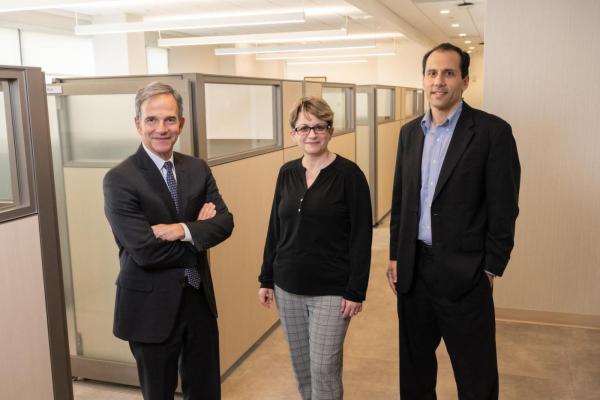
Columbia University has announced a new Center for Innovation in Imaging Biomarkers and Integrated Diagnostics (CIMBID), to be housed in the Department of Radiology, which will leverage AI to enhance patient care. Its director, Despina Kontos, PhD, is pictured (center) here with Diego Jaramillo, MD, PhD (left), professor of radiology and interim chair, and Akiva Mintz, MD, PhD (right), professor of radiology and vice chair of translational research. Image courtesy of Columbia University by Diane Bondareff.
January 18, 2024 — Columbia University Irving Medical Center has announced that Despina Kontos, PhD, a computer scientist and professor of radiology, will lead its new Center for Innovation in Imaging Biomarkers and Integrated Diagnostics (CIMBID). With expertise in artificial intelligence, machine learning, and big data analytics for multi-modality imaging data, Kontos believes Columbia University offers both the perfect location and team to build that path, according to an online news update published Jan. 10 by Columbia University (New York, NY).
CIMBID is a multidisciplinary center that will form collaborations across Columbia, including researchers from biomedical informatics, biomedical engineering, systems biology, the Mailman School of Public Health, and the Herbert Irving Comprehensive Cancer Center.
“I think there is immense untapped potential in this area of research,” said Kontos.
Under Kontos’ leadership, the University reports that CIMBID will be dedicated to developing and integrating quantitative imaging and non-imaging biomarkers for disease prediction, particularly in cancer. Kontos, who made seminal contributions in leveraging artificial intelligence tools for risk prediction in breast and lung cancer while serving as professor of research radiology at the University of Pennsylvania, believes that AI can enable better patient care in three major areas:
• Cancer Screening and Protection — Identifying patients who are at a higher or lower risk for getting the disease and personalizing screening to factor in both risk profile and cost-effectiveness.
• Diagnosis, Prognosis, and Planning Therapy — Quantifying information about a particular disease to help physicians select the most appropriate treatment.
• Evaluation and Response to Therapy — Utilizing data from standard-of-care radiology images to assess whether a patient is responding to therapy early in the treatment process and modify it when it is not working.
“Artificial intelligence is trying to program computers to think like humans,” Kontos said. She continued: “A doctor looks at a report from a radiologist, looks at the notes, considers the family history, comorbidities, genetic tests, etc., and figures out a course of action. With these models, we can try to do that a bit more comprehensively and in a more quantitative and standardized fashion throughout the different stages of patient care.”
She addressed the essential role in collaborating across multiple disciplines and focusing on “team science.” Kontos added: “We can’t think about any of this information in isolation. We are leveraging data science and AI to combine the information from various sources, different modalities, and different approaches, and coming up with more personalized precision algorithms so that we can risk-stratify patients and better take care of them.”
CIMBID will develop initiatives in collaboration with multiple areas at Columbia, including biomedical informatics, biomedical engineering, systems biology, the Mailman School of Public Health, and the Herbert Irving Comprehensive Cancer Center. The research and clinical initiatives will share a common goal of using new approaches to understand the behavior of disease and then translate the findings to patient care.
“The ecosystem at Columbia for this type of research is exceptional,” Kontos said, adding: “We have biomedical informatics, one of the leading departments in the country, with such strong expertise in EHR and informatics. We have genetics, systems biology, and bioinformatics, as well as a strong cancer center. CIMBID will create an environment where all these groups can come together and coalesce in a unique way that can accelerate the development of these algorithms.”
Kontos will serve as vice chair of artificial intelligence and data science research in the Department of Radiology and have joint appointments in the Department of Biomedical Informatics at VP&S and the Department of Biomedical Engineering in Columbia’s engineering school. She is also a member of the Herbert Irving Comprehensive Cancer Center and director of biomarker imaging at NYP, which is supporting the development and application of new AI tools.
About Despina Kontos, PhD
In its published news statement on the new IMBID center, Columbia University offered the following biographical sketch of Despina Kontos, PhD, which our ITN editorial team merited sharing.
Despina Kontos, PhD, is a computer scientist with expertise in artificial intelligence, machine learning, and big data analytics for multi-modality imaging data. She is a professor of radiology and vice chair of artificial intelligence and data science research in the Department of Radiology at Columbia University Irving Medical Center (CUIMC) and director of biomarker imaging at NewYork-Presbyterian Hospital — with additional appointments in the Departments of Biomedical Informatics and Biomedical Engineering. Kontos is also the founding director of Columbia University's Center for Innovation in Imaging Biomarkers and Integrated Diagnostics (CIMBID), a multidisciplinary center dedicated to developing and integrating quantitative imaging and non-imaging biomarkers for personalized disease prediction, particularly in cancer.
Kontos has made seminal contributions to the leveraging of artificial intelligence tools for risk prediction in breast and lung cancer, reported Columbia University in its overview, which added: Her research program focuses on investigating the role of imaging as a quantitative biomarker for improving cancer screening, prognostication, and treatment. She has developed innovative computational methodologies that have enabled the investigation of novel cancer phenotypic biomarkers via imaging, and has translated these biomarkers through extensive clinical and epidemiologic studies to answer important research questions for personalizing cancer care.
With a primary focus on breast cancer, her work has contributed to a fundamental transition in the interpretation of breast cancer images, by showing that imaging data can be mined to extract sophisticated phenotypic signatures with independent diagnostic, prognostic, and predictive value.
Her lab is also pursuing related research in lung cancers, specifically on evaluating the integration of CT radiomic features with liquid biopsy data to characterize lung tumor heterogeneity for predicting response to targeted therapy and immunotherapy.
Research and Publications
- RSNA Research & Education Foundation Fund Development Committee member
- Recipient of numerous grants, from both federal agencies and private foundations, including the National Institutes of Health (NIH), the Department of Defense (DOD), the American Cancer Society (ACS), and the Radiological Society of North America (RSNA)
- Author of more than 100 publications in high-impact journals; nationally-recognized lecturer.
Education and Training
- Studied engineering as an undergraduate at the University of Patras in Greece
- Received her PhD in computer and information sciences from Temple University in Philadelphia, followed by postdoc training in radiology at the University of Pennsylvania.
- Has certificates in Biostatistics and Epidemiology from the University of Pennsylvania; Cancer Biology and Targeted Therapeutics from Harvard University; and AI for Decision Making: Business Strategies and Applications from the Wharton School of Business.
More information: www.cuimc.columbia.edu

 October 07, 2026